Table of Contents
Barbra Banda calls herself a normal girl from Zambia. This is the thing she says when asked to characterise herself, and she says it without apparent irony. The career that surrounds the description includes: back-to-back Olympic hat-tricks against the Netherlands and China at Tokyo 2021, the first player in Women's World Cup history to score a hat-trick in back-to-back tournament games. A ban from WAFCON 2022 because CAF's gender verification process determined her testosterone levels exceeded the permissible threshold for women's competition. The second-highest transfer fee in women's football history. The BBC Women's Footballer of the Year award. A daily training partnership with Marta, the player she calls the greatest of all time. An NWSL single-season goals record with twenty in her debut campaign. And four goals in one match at WAFCON 2026 in Casablanca, in a stadium that was nearly empty, followed by a public statement that the tournament deserved a far larger audience. She is 26 years old. She is, by any serious measure, the most complicated and most compelling figure in African women's football. She is also, by her own consistent account, a normal girl from Zambia.
Lusaka and the Beginning
Banda was born on August 2, 1999, in Lusaka. She grew up in a family where football was not initially a given for a girl, but where the environment around her made it inevitable. She learned the game on informal pitches, progressed through Zambia's junior structures, and made her senior international debut at seventeen years old. By the time she reached Tokyo for the 2020 Olympics in the summer of 2021, she had been playing senior international football for five years and had built a reputation within the CECAFA and COSAFA circuits as a forward of unusual power and precision. Tokyo announced her globally in a way that domestic African women's football had not been able to.
The hat-tricks came in the group stage. Zambia beat the Netherlands 4-3 in a match that defied every expectation attached to a first-time Olympic qualifier facing one of the world's top three programmes. Banda scored three. Against China three days later, she scored another three. Six goals in two Olympic matches, back-to-back hat-tricks, in her first Olympic appearance. The record she set, the first player to score hat-tricks in consecutive Women's Olympic Football Tournament group matches, is the specific statistical achievement that first placed her name in conversations about the women's game's elite tier. She finished that tournament as Africa's all-time top scorer in the competition. She was 21 years old.
The Ban and What It Cost
In 2022, CAF excluded Banda from the Women's Africa Cup of Nations following what the confederation described as a failed gender verification test. The test, which measured testosterone levels, determined that Banda's levels exceeded the threshold CAF had adopted, consistent with World Athletics regulations that were at the time being applied inconsistently across sports governing bodies. The decision was made without public explanation and communicated to Banda and the Football Association of Zambia in terms that both found inadequate. Banda watched the 2022 WAFCON from outside the tournament. Zambia qualified for their first Women's World Cup at that same WAFCON. She was not there to help them do it.
She has spoken about the period with characteristic directness: she described it as a difficult time but said she used it to work on herself and return stronger. She returned to international football for the 2023 Women's World Cup, where Zambia were eliminated in the group stage. She then signed for Orlando Pride, began training alongside Marta, and produced the most productive club season of her career. The 2022 ban is part of her public record and part of the conversation that surrounds her name in sports governance circles. It is not the part she dwells on, at least not publicly. She dwells on the goals.
Orlando, Marta and the Partnership
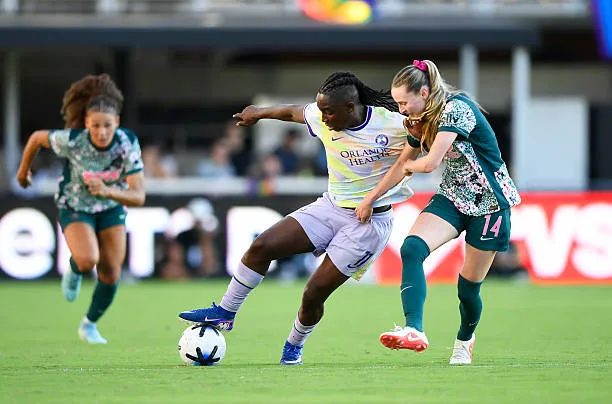
Banda joined Orlando Pride from Shanghai Shengli in 2024 for a transfer fee of $740,000, the second-highest in women's football history at that point, behind only her Zambian teammate Racheal Kundananji's move to Bay FC weeks earlier. The fee placed her inside a club where Marta, the Brazilian forward widely regarded as the greatest women's footballer in history, was also playing. Their partnership has been the most discussed attacking combination in the NWSL since its formation.
Banda has been explicit about what training with Marta means to her. She told ESPN that she always has good conversations with Marta, that she is a wonderful person and someone she is learning from every day, and that Marta is the GOAT. She said it without qualification. The context of that statement matters: Banda is herself a contender for the title she is attributing to her teammate. She has won the BBC and CAF Women's Player of the Year awards. She has scoring records at the Olympics. She scored four goals in a WAFCON match at 26. If there is a next generation of player capable of challenging Marta's legacy in the women's game, Banda is the most specific name attached to that argument. She does not make the argument herself. She calls Marta the GOAT and goes back to training.
The Numbers and the Next Chapter
Across 57 appearances for Orlando Pride since her arrival in 2024, Banda has scored 37 goals. Her debut NWSL season produced a single-season record of 20 goals. She won the Golden Boot and MVP award. She helped the Pride win the NWSL Shield and their first NWSL Championship. Her second season was interrupted by injury. She returned in 2026 to lead the NWSL scoring charts with 12 goals before the WAFCON break, then scored five more in Morocco. She is contracted to Orlando until 2028. She is 26.
Zambia did not reach the WAFCON semi-finals and will not be in Brazil automatically. They are not in the playoff draw either: the inter-confederation playoff places went to South Africa and Ghana as the WAFCON quarter-final exits who beat each other in the relevant bracket. Zambia's path to the 2027 Women's World Cup is effectively closed. That is the one chapter of this summer that has not resolved the way Banda needed it to. She came to Morocco, scored five goals in three matches, was eliminated in the quarter-finals, and then watched Malawi reach the final and Cameroon win the trophy. The goals were there. The team journey was not. She described everything as starting from WAFCON before the tournament. The tournament has ended. The work continues.