Football analysis has become one of the most powerful forces shaping the modern game. Beyond the ninety minutes, narratives are built in studios, reputations are influenced in real time, and tactical understanding is translated for millions of viewers across continents. In this evolving ecosystem, African voices are no longer confined to the pitch. They are now central to how football is interpreted globally.
This shift reflects a bigger structural change. As African football grows through stronger domestic leagues, increased CAF competition visibility, and expanded broadcasting networks, there is a parallel rise in African-born analysts occupying influential media roles. Platforms such as SuperSport, BBC Sport, and Canal+ Afrique have increasingly relied on African expertise to contextualize both continental and global football.
These pundits are not simply former players filling studio seats. They are interpreters of systems, translators of tactical nuance, and cultural bridges between African football and the global game. This ranking evaluates ten of the most influential African-born pundits in 2026 and their ability to shape football discourse.
10. Lucas Radebe (South Africa)
Affectionately known as "The Chief," Lucas Radebe has successfully translated his legendary defensive leadership into a sophisticated career in football media. His punditry journey reached a global peak during the 2010 FIFA World Cup, where he served as a prominent analyst for ITV Sport and a specialist columnist for The Daily Telegraph.
On the screen, Radebe is a mainstay for SuperSport, where he is lauded for his ability to dissect the mental and tactical nuances of defending. He often challenges the structural status quo of African football, advocating for local expertise and better management. In a notable critique of the continent’s reliance on short-term foreign coaching, Radebe told The Guardian:
"I don't think we believe in our own coaches, so we bring in European coaches and it doesn't work... This World Cup was a great opportunity for local coaches to showcase our type of football, but that's not the way it's gone."
His voice remains one of the most authoritative in the game, blending his status as a Leeds United icon with a deep commitment to elevating African footballing standards.
9. Emmanuel Adebayor (Togo)
Since retiring in March 2023, Emmanuel Adebayor has quickly built a reputation as a bold and outspoken pundit. By February 2026, he had become a regular analyst on Premier League Productions, where his direct style often sparks debate.
Following Arsenal’s 4–1 victory over Tottenham Hotspur in February 2026, Adebayor revealed, according to YEN.com.gh, that he had studied the remaining schedule and was unconvinced by Arsenal’s momentum. “I have looked at the next fixtures for both Arsenal and City. I think City will win the league,” he explained, emphasizing the importance of analyzing the full run-in rather than one high-profile win.
Adebayor’s punditry is noted for its focus on identity and the psychological atmosphere of the locker room. Rather than focusing solely on heat maps, he emphasizes the "soul" of the competition. Reflecting on the evolution of the continental game in an interview with CAFonline on January 1, 2026, Adebayor highlighted how the tournament has become a canvas for African pride:
“Now it’s beautiful. It’s art. It’s our culture... We play different, we dress different, we talk different. At the end of the day, we must remember that we are Africans. We have our values.”
8. Joseph Yobo (Nigeria)
Joseph Yobo represents the evolution of the "defensive mastermind" in African punditry. Since retiring as a Super Eagles legend, he has anchored his broadcasting career at SuperSport, where he is celebrated for translating his on-field leadership into structured tactical breakdowns. While his style is often more measured and clinical than his contemporaries, his ability to predict tournament dynamics has made him a trusted voice across the continent.
By early 2026, Yobo had become a leading authority on the psychological pressure of major tournaments. Ahead of the 2025 AFCON (held in early 2026), Yobo used his platform to warn the current Nigerian squad against the dangers of complacency in the early stages. Speaking to ESPN, Yobo emphasized the necessity of clinical preparation:
"A good start is very important. The first two games are very important. It is very, very crucial... It's in our hands, and it comes down to how well do we prepare, how badly do we want it?"
Yobo enriches the football conversation by pairing tactical precision with a demand for accountability, advocating for elevated organizational standards across both the Nigerian national team and the domestic league.
7. John Obi Mikel (Nigeria)
John Obi Mikel has built a formidable reputation as a broadcast analyst by blending technical expertise with the elite-level composure he was known for during his trophy-laden years at Chelsea. During the 2025 FIFA Club World Cup in the United States, he served as a marquee pundit for DAZN, where he excelled at breaking down complex midfield rotations and the physical demands of high-press systems.
Mikel’s delivery is characterized by a "player-first" perspective that simplifies tactical jargon into relatable insights. He is particularly adept at identifying how specific profiles can alter a team's tactical ceiling. Speaking to DAZN in June 2025, during the group stages of the FIFA Club World Cup as Chelsea prepared to face SL Benfica, Mikel highlighted how the inclusion of a traditional physical presence changed their offensive dynamic:
“His movement on the pitch… he’s very physical, and he will score goals for us.”
His analysis carries a weight of authority that resonates across international platforms, making him one of the most credible African voices currently interpreting the global game.
6. Wael Gomaa (Egypt)
Nicknamed “The Rock,” Wael Gomaa brings intensity and authority to punditry. As a key analyst on beIN SPORTS, he is known for his uncompromising defensive analysis and strong opinions.
During the AFCON 2025 third-place playoff between Egypt and Nigeria in January 2026, Gomaa told beIN SPORTS he was frustrated by the hostile atmosphere in Casablanca. “You said the match was taking place at the Mohammed V Complex in Casablanca? I have the impression it's being played in Lagos, Nigeria,” he remarked, criticizing the fans’ behavior. He added, “We’ve honestly reached a difficult stage,” highlighting his concern for the decorum expected in international football.
By blending this candid emotion with high-level defensive analysis, Gomaa provides a unique brand of punditry that holds players and organizers alike to an elite standard of accountability.
5. Ahmed Hassan (Egypt)
Known as "The Dean," Ahmed Hassan has utilized his status as a four-time AFCON winner to become a premier voice in Middle Eastern and African sports media. Since retiring, he has established himself as a tactical match analyst for beIN SPORTS and other major Egyptian networks, where he focuses on the psychological and structural requirements for continental dominance.
Hassan’s punditry often centers on the importance of collective identity over individual stardom. During the 2025 AFCON in Morocco, where he served as an official analyst and ambassador, he provided a critical assessment of the current Egyptian squad's dynamic. Speaking to CAFOnline on December 25, 2025, following the conclusion of the tournament's opening fixtures, Hassan addressed the balance between global superstars and team cohesion:
“Salah is a world-class player, without question, but football is a team sport. Success comes when everyone plays for the jersey, for the team, and for the country.”
His commentary during the 2025/2026 season has been particularly focused on the "rising standards" of the game, consistently using his platform to bridge the gap between Egypt’s historic golden era and the modern, more technically diverse African landscape.
4. Didier Drogba (Ivory Coast)
Didier Drogba has evolved into a sophisticated tactical analyst, leveraging his experience under managers like José Mourinho to provide deep-dive technical breakdowns for global networks. While often appearing in ceremonial roles, his punditry, particularly with the BBC and beIN SPORTS, is noted for its focus on the "complete striker" and the evolution of offensive systems.
Rather than offering generic praise, Drogba’s analysis dissects the movement and intelligence required to compete at the elite level. During the 2022 FIFA World Cup, as a lead analyst for the BBC, he provided an extensive breakdown of modern forward play, highlighting why versatile attackers have superseded traditional goal-poachers. Speaking to the BBC on December 3, 2022, Drogba explained the value of a striker who contributes beyond the scoresheet:
"For me, a complete striker is someone who can create an assist as well as score—someone who can change the game within one action... it is not just about the goals they score, they bring much more."
Heading into 2026, his influence has expanded to the FIFA+ platform, where he has become a leading voice on the technical growth of African clubs. He has consistently argued that the expanded 2025 FIFA Club World Cup format is essential for the tactical maturation of the African game, stating in a FIFA.com interview on April 19, 2024, that the competition provides the necessary "opportunity for them to show what they are capable of" against the world’s tactical elite.
3. Jay-Jay Okocha (Nigeria)
Jay-Jay Okocha combines charisma and sharp football intelligence, making him one of Africa’s most engaging pundits. Since joining SuperSport in 2019, he has become a fan favorite for his engaging and creative analysis.
In December 2025, a Pulse Sports Nigeria social media post outlined that Okocha argued that the AFCON 2025 Super Eagles could not match Nigeria’s legendary 1996 Olympic team. “They will collect,” he stated bluntly, sparking widespread debate about the quality and potential of the current squad.
Okocha’s perspective is anchored in the space where historical greatness meets current expectations. He routinely challenges both the audience and the athletes by delivering critical insights through a charismatic lens, ensuring his viewpoints remain a central part of the footballing conversation.
2. Samuel Eto'o (Cameroon)
Samuel Eto’o is a high-level technical analyst whose commentary carries the weight of one of the most decorated careers in football history. He is a recurring expert for beIN SPORTS and France 24, where he specializes in deep-dive assessments of elite management and the systemic challenges facing African teams on the global stage.
Eto’o’s analysis is noted for its uncompromising stance on the integrity and technical standards of the game. During the 2025 AFCON in Morocco, he emerged as a prominent voice on the evolution of African officiating. In a widely cited interview with France 24 on January 20, 2026, Eto’o addressed the controversial decisions that occurred during the tournament:
“The referees remain humans... but there were game events that have marked this AFCON forever. Now it is up to CAF to take responsibility and see what has worked less.”
Beyond officiating, his punditry often focuses on the psychological demands of leadership. Following the 2025 AFCON Final, Eto'o praised the impact of Sadio Mané, stating that his ability to lead during high-pressure moments was "exceptional." By blending technical insight with sharp critique, Eto’o remains one of the most influential African voices in sports media.
1. Teko Modise (South Africa)
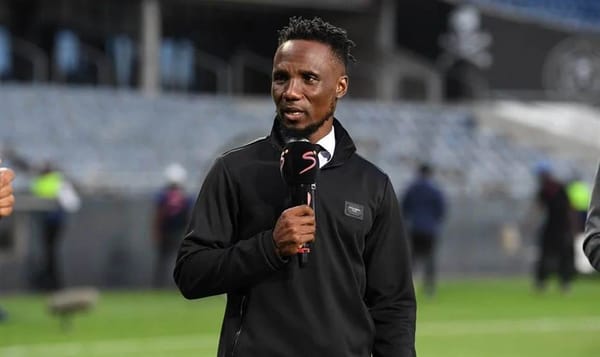
Teko Modise has become a leading voice in African football analysis, combining tactical insight with clear, engaging delivery on SuperSport. He regularly breaks down South African Premier Division and AFCON matches, offering detailed explanations of formations, substitutions, and player decision-making. A central figure on SuperSport, he combines tactical depth with confident delivery.
On February 15, 2026, Modise predicted Orlando Pirates’ league success based on consistency and squad quality. During AFCON 2025, Modise’s post-match review of Bafana Bafana’s defeat to Cameroon, posted on 1 January 2026, drew over 7,000 views on SuperSport’s YouTube channel. In the video, he highlighted substitution timing and risk-taking:
"After conceding that second goal, that's when you're supposed to make those changes…we need to start taking risks and trust the players on the bench."
This analysis showcased his ability to assess tactical decisions in real time and communicate them clearly, reinforcing his authority as a top African pundit.
African Voices Shaping the Global Game
The rise of these pundits marks a shift from Africa as a source of talent to a source of football intelligence. By providing unrivaled cultural and tactical context, these analysts have moved from mere representation to genuine global influence. As the demand for authentic expertise grows, Africa is no longer just playing the game; it is explaining it.

Related News
From Gomaa to Koulibaly: The Greatest Centre-Back Partnerships in African Football
Mar 16, 2026
Top 10 African Female Footballers to Watch at WAFCON 2026
Feb 21, 2026
Top 10 Most Expensive Transfers Between African Football Clubs
Feb 16, 2026