Table of Contents
The nickname came from his older brother. James Okocha played football too, and when the younger brother began tagging along and showing something that nobody else on the street in Enugu could do, James started calling him Jay-Jay. The name had no specific meaning. It was just the sound of something joyful. It followed Augustine Azuka Okocha from the dusty pitches of Enugu to the Bundesliga, to Turkey, to Paris, to Bolton, and into a place in African football history that no amount of biographical recap can fully account for. Some players are best understood through their statistics. Okocha is best understood through specific moments. The moments, when collected, form a picture of a man who treated the football pitch as a space where the normal rules of physics were negotiable.
Germany: The Goal That Changed His Life
Okocha arrived in Germany in 1990 on a visiting visa, accompanying his brother to a trial at Borussia Neunkirchen. James could not attend. The club, needing bodies for the session, invited Augustine instead. He dribbled past everyone. They offered him a professional contract on the spot. He was seventeen years old and had come to Germany as a passenger. He left as a footballer.
Two years later he signed for Eintracht Frankfurt, then a Bundesliga club with continental ambitions. He scored 18 goals in 90 Bundesliga appearances , respectable numbers for an attacking midfielder at that level. The statistics do not explain what happened on August 31, 1993. Frankfurt were playing Karlsruher SC at the Wildparkstadion. The match was in the 87th minute. Frankfurt were winning 2-1 and Okocha came on as a substitute. He received the ball on a counter-attack with Oliver Kahn , the man who would go on to be called the world's best goalkeeper for a decade , standing between him and the net.
What followed has been described, replayed, and dissected for thirty-two years. Okocha shaped to shoot. Kahn did not move. He shaped again. A defender arrived. He dribbled past the defender. Another arrived. He dribbled past him too. Then another. In the time it took for five players to be beaten, he covered perhaps fifteen metres of ground while the ball barely left his feet. He fired it into the net between two recovering defenders. Kahn, later, said he was still dizzy. Jürgen Klopp, decades later, called it the greatest goal in Bundesliga history. Okocha himself called it the best of his career and said he had not planned any of it , each feint was a response to someone arriving in front of him. It won the ARD Goal of the Year. It made him famous outside Germany. It changed his life. His words.
Turkey: The Free-Kick Years
Okocha left Frankfurt in 1996 following a falling-out with manager Jupp Heynckes , a feud that also ended the Frankfurt careers of Tony Yeboah and Maurizio Gaudino and contributed to the club's relegation. He signed for Fenerbahçe in Istanbul for approximately £1 million. In two seasons there he scored 30 goals in 62 appearances. The numbers are striking for a midfielder. The method was more striking still: a significant portion of those goals came from direct free-kicks, many of them from positions where the angle suggested a cross was the sensible option. Okocha had developed a technique for bending the ball at pace that goalkeepers struggled to track. He wore red boots in an era when black was the norm. He acquired Turkish citizenship during his time at the club, taking the name Muhammed Yavuz , explaining later that he chose Muhammed for its widespread use in Islam, though he did not change his own religion, and Yavuz to honour a staff member he admired. He was not a man who did things the obvious way.
Atlanta 1996: Africa's Greatest Day
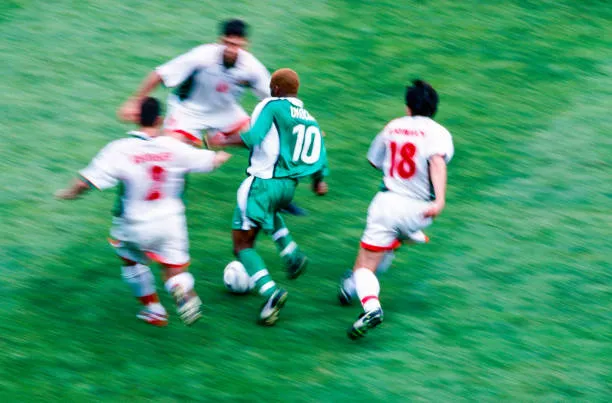
In the summer of 1996, between his Frankfurt exit and his Fenerbahçe arrival, Okocha played in the Atlanta Olympic Games as part of a Nigeria squad that has since been recognised as one of the finest collections of African football talent ever assembled. The tournament unfolded in a manner that still seems improbable. Nigeria came back from 3-1 down to beat Brazil in the semi-final. They came back from 2-0 down to beat Argentina in the final. They won the gold medal. They became the first African nation to win Olympic gold in football.
The team contained Nwankwo Kanu, Celestine Babayaro, Sunday Oliseh, Taribo West, Daniel Amokachi, and Tijani Babangida. It was coached by Johannes Bonfrère. Okocha was the creative engine in midfield , the player whose ability to hold the ball, create under pressure, and find solutions in tight spaces gave the team its identity. He described the gold medal as the happiest day of his life, which places it above the Oliver Kahn goal, above PSG, above Bolton, above everything else in a career that had no shortage of days worth remembering. The 1996 Super Eagles are not a footnote in African football history. They are the proof of concept , the evidence, produced at a moment when the continent needed it, that African football could not simply compete but could win against anyone on the planet.
Paris: The $17 Million Man and the Young Brazilian
In 1998, Okocha signed for Paris Saint-Germain for $17 million , the largest fee ever paid for an African player at the time. It was the record transfer for a Nigerian footballer. The number announced him to a wider audience, but it was what happened at PSG that defined this period of his career. In the 2001-02 season, PSG also had a young Brazilian midfielder arriving from Grêmio who was unlike anyone else on the pitch. His name was Ronaldinho.
Okocha later said that the best teammate he ever had was Ronaldinho , because when you play with someone who thinks the same way you do, you don't need to communicate. You just look at each other and know. It is a sentence worth sitting with. Okocha, who had spent a decade being described as unrepeatable, recognised in Ronaldinho the same sensibility , the same instinct to treat a football match as a creative problem rather than a physical contest. They played together for one season. PSG were not a successful club during Okocha's four years. He scored 12 goals in 79 appearances, a modest return by any measure. But the $17 million African record fee, the Ronaldinho partnership, and the 2001 UEFA Intertoto Cup , in which he scored five goals as PSG became joint champions , meant the Paris years were not a detour. They were the bridge to Bolton.
Bolton: The Terrace Chant That Became a Shirt
He joined Bolton Wanderers in 2002 on a free transfer, at 28 years old, for a club managed by Sam Allardyce in the English Premier League. The pairing should not have worked. Allardyce's Bolton were direct, physical, set-piece oriented , a team built to survive rather than to entertain. Okocha was the most extravagantly technical player in the Premier League. Allardyce, to his credit, understood that some players perform best when the system bends around them. Okocha was given freedom to express himself within a structure that was otherwise about survival. He expressed himself.
He won Premier League Player of the Month in November 2003. He captained Bolton to the 2004 League Cup final, where they lost to Middlesbrough. He scored free-kicks that went in from angles that defied the architecture of the penalty box. He nutmegged defenders who were specifically trying not to be nutmegged. He made Bolton Wanderers , a club from a factory town in Lancashire with no previous claim to glamour , one of the most watched teams in the Premier League, because on any given afternoon he might do something that had never been done before. The supporters invented the chant. The club printed it on shirts. Jay-Jay Okocha, so good they named him twice. He played 142 matches for Bolton across four seasons. In a career full of larger clubs and larger fees, this is the chapter that most people remember.
Nigeria: 73 Caps and the Weight of a Generation
Okocha represented Nigeria from 1993 to 2006, earning 73 caps and scoring 14 goals. The caps span three World Cups , 1994 in the United States, 1998 in France, 2002 in South Korea and Japan , and multiple Africa Cup of Nations campaigns. He was never named African Player of the Year, an omission that remains one of the award's more debated gaps. In 2003 and 2004 he won the BBC African Footballer of the Year , the only player to win it in consecutive years , but the CAF individual prize eluded him throughout a career in which he was, by widespread agreement, the most technically gifted African player of his generation.
The trophy he did win , the 1994 AFCON with Nigeria, and the 1996 Olympic gold , are the collective achievements that place him alongside the legends of African football rather than simply among its most entertaining players. He was not a player who existed outside of context. He was a captain, a leader, a creative force who operated at the highest level of competitive football for 16 years. The Super Eagles of 1994 to 2002 were built partly around his ability to find solutions that other players could not find. His nephew, Alex Iwobi, has described Okocha as the reason he chose to represent Nigeria rather than England. The influence runs forward as well as backward.
What He Left Behind
Okocha retired from professional football in 2008 after a final season at Hull City. He was 34. He has since worked as a television analyst, appeared in charity matches, founded the Jay-Jay Okocha Foundation , which uses football as a vehicle for education, peace and unity , and remained a visible figure in Nigerian and African public life. He is 52 years old now. He is, without serious challenge, the greatest Nigerian footballer in history and one of the ten greatest African players the game has produced.
What he left behind is harder to quantify than trophies or transfer fees. He left behind the Oliver Kahn goal, which Eintracht Frankfurt repost every year on its anniversary because they cannot help it. He left behind the image of a Nigerian captain lifting a gold medal in Atlanta in 1996 , the moment that told an entire continent that African football did not need to apologise for its ambition. He left behind a chant that Bolton Wanderers fans still sing, three decades on, for a player who wore red boots before red boots were acceptable and dribbled past people who specifically knew he was going to dribble past them and still could not stop him.
He learned football on the streets of Enugu with whatever round object was available. He ended his career having scored one of the most replayed goals in football history, won Olympic gold against Brazil and Argentina in the same tournament, signed for PSG for an African record fee, captained Bolton to a cup final, and mentored Ronaldinho. The name his brother gave him, the one that meant nothing specific and everything joyful, turned out to be the right name. It was so good they said it twice.