

Few things in football ignite instant debate like a late VAR decision. One moment, the crowd is celebrating a goal or a brilliant defensive play, and the next, a video review halts play, leaving players, coaches, and fans in stunned silence.
In African football, these high-stakes interventions have become increasingly common, transforming the closing stages of matches into arenas of drama and controversy. Across the continent, from AFCON finals to CAF Champions League knockout ties, VAR has played a pivotal role in shaping outcomes, sometimes clarifying errors, and at other times fueling confusion and frustration.
The stakes could not be higher. In Africa, where football carries immense national pride, a single replay can decide titles, influence qualification paths, and even alter careers. Yet the continent’s competitions are played in stadiums with varying technological resources, from cutting-edge broadcast facilities to venues struggling with basic replay capabilities. This uneven landscape has led to a series of controversial calls that linger long after the final whistle. Matches have been defined not only by goals and heroic plays but by VAR interventions that spark debates about fairness, consistency, and the human element in officiating.
As African football continues to embrace technology, the tension between clarity and controversy has never been more pronounced, illustrating that even in the era of VAR, drama remains inseparable from the sport. The incidents below are among the most controversial VAR decisions in African football, showing how technology can both decide matches and spark intense debate.
6. Egypt vs South Africa VAR Standoff (2025)
On 26 December 2025, Egypt national football team secured a narrow 1–0 victory over South Africa national football team at Stade Adrar in the 2025 Africa Cup of Nations, a match defined by controversial decisions. The winning goal came from a 45th-minute penalty, awarded after South African defender Khuliso Mudau’s arm contacted Mohamed Salah’s face. Following a lengthy VAR review, referee Pacifique Ndabihawenimana pointed to the spot, and Salah converted calmly.
The decision drew widespread criticism. Ahmed Walid and Nick Miller of The Athletic noted, “There seemed to be only two people watching who thought Mudau had actually committed an offence worthy of being penalised — the VAR and the on-pitch referee.” Former defender Lauren also questioned the call, emphasizing that Mudau’s arm was part of his running motion.
Egypt’s advantage was further complicated when Mohamed Hany received a second yellow card just before halftime, reducing Egypt to ten men. Late in stoppage time, South Africa appealed for a penalty after Yasser Ibrahim handled the ball, but VAR ruled otherwise. The contrasting outcomes of these pivotal moments deepened the controversy surrounding the officiating. As Ahmed Walid and Nick Miller of The Athletic noted, “There seemed to be only two people watching who thought Mudau had actually committed an offence worthy of being penalised — the VAR and the on-pitch referee.” When compared with the later decision not to award South Africa a penalty for handball, the episode illustrated the perception among critics that VAR interventions in African competitions can appear inconsistent from one moment to the next. In that sense, the match became a striking example of how technology intended to reduce refereeing disputes can sometimes amplify them.
5. Young Africans vs Mamelodi Sundowns “Goal That Wasn’t” (2024)
The CAF Champions League quarterfinal between Young Africans (Yanga) and Mamelodi Sundowns took place on 5 April 2024 at Loftus Versfeld Stadium and ended in controversy despite Sundowns eventually progressing 3–2 on penalties. The match became the subject of debate after a key decision in the 57th minute, when Young Africans midfielder Stephane Aziz Ki appeared to score what many believed was a legitimate goal. However, Mauritanian referee Dahane Beida disallowed the goal, and notably did not review the incident on the pitch-side monitor even though VAR technology was available.
After the match, Young Africans submitted an official complaint to the Confederation of African Football, alleging both an administrative error and possible match manipulation. According to reporting by TimesLIVE, the club stated: “Despite the availability of video assistant referee (VAR) technology, Mr Beida and his team intentionally neglected to review the goal incident through VAR, thereby disregarding the principles of fair play and justice in football.”
The controversy raised serious concerns about refereeing standards and the consistent use of VAR in major African club competitions.
4. WAFCON Final Penalty Reversal (2025): Nigeria vs Morocco
One of the most debated VAR decisions in African women’s football came during the 2024 Women’s Africa Cup of Nations final, when Morocco were denied what their coach believed was a decisive penalty after a VAR intervention. Late in the match, referee decisions reviewed through VAR overturned a penalty appeal from the Moroccan side, a moment that Morocco head coach Jorge Vilda strongly contested after the final whistle. Speaking to ESPN, Vilda said: “We can’t understand the decision made by the referee… there was a hand, but the referee took it off us.” The decision immediately became one of the most disputed moments of the tournament.
The controversial call came in a final that had already produced dramatic swings in momentum. On 27 July 2024 at Prince Moulay Abdellah Olympic Stadium, the Nigeria women's national football team overturned a two-goal deficit to defeat the Morocco women's national football team 3–2. Morocco had stunned the home crowd early, racing into a 2–0 lead inside the opening 25 minutes through Ghizlane Chebbak and Sanaa Mssoudy.
But the Super Falcons, already Africa’s most decorated women’s side, mounted a ruthless second-half comeback. Esther Okoronkwo converted a 62nd-minute penalty, before Folashade Ijamilusi bundled home the equalizer. With the momentum firmly swinging, Jennifer Echegini struck from close range in the 88th minute, sealing Nigeria’s 10th continental title, according to reporting by ESPN.
As detailed by ESPN journalist Ed Dove, the disputed VAR decision ultimately reshaped the narrative of a final remembered as much for its officiating debate as for Nigeria’s comeback victory.
3. Senegal vs Algeria Penalty Reversal (2019)
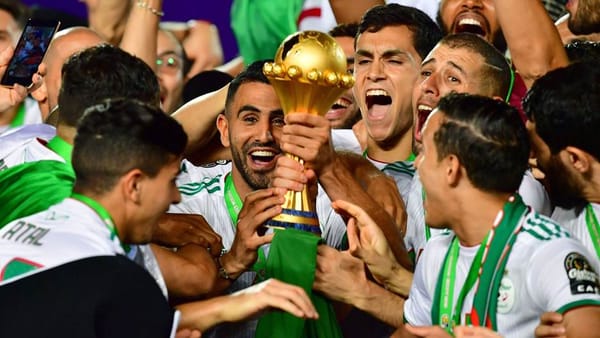
Another major African football controversy occurred during the 2019 Africa Cup of Nations final on 19 July 2019, when the Algeria national football team defeated the Senegal national football team 1–0 at Cairo International Stadium to claim their second AFCON title, their first since 1990.
The decisive moment arrived almost immediately. After just 79 seconds, striker Baghdad Bounedjah struck from distance and his shot deflected off defender Salif Sane, looping high into the air before dropping into the net. According to CNN, it proved to be Algeria’s only shot on target in the entire match, yet it ultimately secured the trophy.
Despite conceding early, Senegal dominated possession and pressed for an equalizer throughout the remaining 88 minutes, led by star forward Sadio Mane. The most controversial moment came midway through the second half when referee Alioum awarded Senegal a penalty for handball against midfielder Adlene Guedioura. However, after consulting the Video Assistant Referee and reviewing the incident on the pitch-side monitor, Alioum overturned his decision.
The reversal sparked confusion among players and fans inside the stadium. As CNN reported while describing the incident, “after being advised by the Video Assistant Referee to review the incident on the pitch side monitor, Alioum overturned his original decision.” CNN’s reporting confirmed the sequence: the referee consulted VAR, reviewed the monitor, and reversed his original award.
The overturned penalty became the defining controversy of the final — the moment most cited by Senegalese players and commentators in the immediate aftermath, according to post-match coverage by CNN and AFP.
2. Mali vs Tunisia VAR Chaos (2021)
One of the most chaotic officiating incidents in recent football history occurred during the 2021 Africa Cup of Nations match between Mali and Tunisia. The controversy centered on referee Janny Sikazwe, who stunned players and fans by ending the match twice before the full 90 minutes had been played. According to ESPN journalist Ed Dove, Sikazwe first blew for full time at 85 minutes and 11 seconds, before allowing play to continue briefly and then ending the game again at 89 minutes and 42 seconds, still short of the regulation 90 minutes.
The confusion followed a match already filled with contentious decisions, including two penalty calls and a red card that had been reviewed by VAR. Given those interruptions, many observers expected significant stoppage time. Instead, the premature whistle triggered outrage from the Tunisian team, who chased the referee before security escorted him off the pitch.
Tunisia coach Mondher Kebaier expressed disbelief at the decision. As reported by ESPN, he told journalists: “I’ve been coaching for almost 30 years, and I’ve never seen a situation like this. The decision is inexplicable.”
The episode quickly became one of the most discussed refereeing controversies in international football.
1. Senegal vs Morocco AFCON Final Walk-Off (2025)
One of the most dramatic stoppage-time controversies in African football unfolded during the 2025 Africa Cup of Nations final between Senegal and Morocco at the Prince Moulay Abdellah Stadium in Rabat.
With the score locked at 0–0 deep into stoppage time, Senegal believed they had found the decisive breakthrough in the 92nd minute when Crystal Palace forward Ismaïla Sarr bundled the ball into the net after a corner. However, referee Jean-Jacques Ndala ruled out the goal for a foul in the build-up following a VAR consultation.
Moments later, the drama escalated further. In the 98th minute, Morocco were awarded a penalty after VAR advised the referee to review a challenge by Senegal defender El Hadji Malick Diouf on Brahim Díaz. The decision triggered chaotic scenes.
According to BBC Sport journalist Keifer MacDonald, “head coach Pape Thiaw, still incensed by Ndala's decision moments earlier to disallow a Senegal goal, ushered his team off the field.” The players remained in the tunnel for roughly 17 minutes before returning to complete the match.
Morocco’s Brahim Díaz attempted a Panenka from the spot, but Édouard Mendy calmly caught the effort. Senegal eventually seized the moment in extra time when Villarreal midfielder Pape Gueye thundered home the winner in the 94th minute of added play.
As ESPN’s Ed Dove reported after the match, “the contest descended into controversy and violence in second-half injury time after a pair of refereeing decisions that ruled out a Senegal goal at one end and then awarded a Morocco penalty at the other.” Senegal ultimately lifted their second AFCON crown, winning 1–0 after extra time.
VAR and the Future of African Football
Taken together, these incidents highlight a deeper challenge facing African football: the need for consistent and transparent implementation of VAR across all major competitions. While the technology was introduced to eliminate clear refereeing errors, its effectiveness depends heavily on infrastructure, training, and clear procedural standards.
In several of the cases above, the controversy was not simply about a single decision but about uncertainty surrounding how and when VAR should intervene.
For CAF, the lesson is clear. If the organization hopes to maintain confidence in officiating, it must continue investing in standardized technology, clearer communication between referees and VAR officials, and stronger post-match accountability when controversial decisions occur.
Without those reforms, the very system designed to bring clarity to the game risks becoming another source of dispute in African football’s most important matches.
Related News
From Tourism to Controversy: The Story Behind Arsenal’s Visit Rwanda Sleeve Deal
Mar 08, 2026
Unforgettable Key Moments in the Dramatic AFCON 2025 Final
Jan 19, 2026
Top African Football Commentators in 2025
Aug 14, 2025