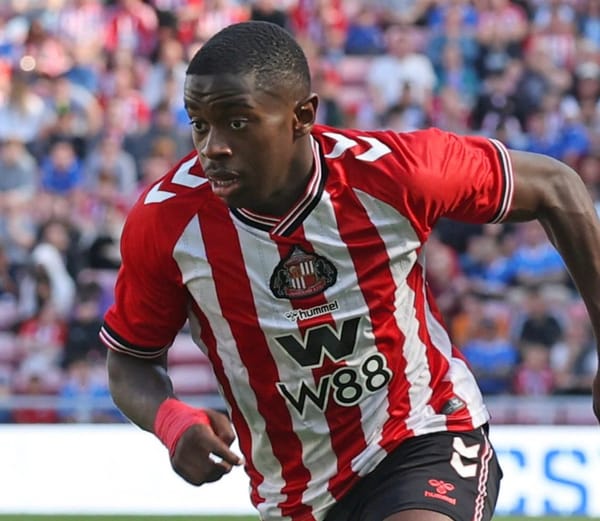
Noah Sadiki’s emergence at Sunderland represents more than a promising young footballer finding his feet in English football. It is a story shaped by modern African identity, European development systems, and the increasingly complex routes African-eligible players take to the top of the game.
At just 20, Sadiki has already navigated elite academies, top-flight European football, and international allegiance decisions—offering a clear window into how African football talent is being formed, filtered, and re-imagined in the global era.
Early Life and Football Development
Born on December 17, 2004, in Brussels, Noah Sadiki grew up within one of Europe’s most structured football environments. He joined RSC Anderlecht’s academy at a young age and progressed through its ranks, benefiting from a system known for producing technically sound and tactically intelligent players.
Unlike many African stars whose stories begin on informal pitches, Sadiki’s foundation was shaped by elite coaching, positional discipline, and game intelligence. This background would later define his playing style: calm in possession, disciplined without the ball, and adaptable across midfield and defensive roles.
Sadiki signed his first professional contract with Anderlecht in 2022 and gained senior experience through appearances for both the first team and RSCA Futures, the club’s reserve side competing in Belgium’s professional leagues.
Building Momentum in Belgian Football
In 2023, Sadiki moved to Union Saint-Gilloise, a club that has emerged as one of Belgium’s most tactically progressive sides in recent seasons. The move proved pivotal.
At Union SG, Sadiki transitioned from academy graduate to reliable senior contributor. He featured regularly in domestic competition and gained exposure to European football, developing the physical and mental attributes required at the highest level.
This stage of his career highlights a broader African-sports reality: development does not always require immediate spotlight. Incremental growth, competitive minutes, and tactical responsibility often matter more than early stardom.
The Sunderland Move: Opportunity Over Hype
Sadiki’s transfer to Sunderland AFC marked a new chapter—one defined by intensity, physicality, and adaptation. English football, particularly outside the glamour tier, is unforgiving for young players. Minutes must be earned, not gifted.
At Sunderland, Sadiki has been viewed as a long-term midfield investment rather than an instant headline signing. His versatility—capable of operating as a defensive midfielder, central midfielder, or auxiliary defender—fits the modern English game’s demand for tactical flexibility.
Rather than being judged by goals or assists alone, his value lies in ball retention, defensive awareness, pressing intelligence, and positional discipline—qualities often underrepresented in mainstream narratives around African players.
Playing Style: Intelligence Before Flash
Noah Sadiki’s game is defined less by spectacle and more by control.
He is:
- Positionally disciplined
- Comfortable receiving the ball under pressure
- Strong in interceptions and recoveries
- Efficient rather than extravagant in distribution
This profile reflects a growing shift in how African midfielders are developed and perceived. The stereotype of purely physical African players is steadily giving way to a new generation shaped by tactical schooling and adaptability.
Sadiki belongs to that generation.
Choosing DR Congo: Identity and African Football’s Pull
Despite representing Belgium at youth international level, Sadiki chose to commit his senior international future to the Democratic Republic of Congo in 2023.
This decision is increasingly common among dual-national players of African heritage—and deeply significant.
For African football, such choices:
- Strengthen national teams with European-trained talent
- Reinforce identity and cultural connection
- Shift competitive balance in continental tournaments
Sadiki made his senior debut for DR Congo in Africa Cup of Nations qualification, becoming part of a national setup seeking renewed continental relevance.
His decision reflects a wider truth: African football is no longer a fallback option—it is a conscious, proud choice.
Why Noah Sadiki’s Story Matters Beyond Sunderland
Sadiki’s rise offers key insights into African sport today:
1. African Talent Is Being Shaped Globally
African footballers no longer follow a single path. Sadiki’s Belgian upbringing and Congolese identity coexist, producing a player comfortable in multiple football cultures.
2. Development Is Replacing Raw Exposure
His journey shows the value of structured progression over early hype—a model increasingly producing sustainable careers.
3. Identity Shapes Modern African Football
National allegiance decisions now carry cultural, emotional, and strategic weight, strengthening African teams competitively and symbolically.
A Career Still Being Written
Noah Sadiki is not yet a finished product—and that is precisely why his story matters.
At Sunderland, with DR Congo, and within a shifting global football ecosystem, he represents a generation of African-eligible players defined by:
- Patience over publicity
- Intelligence over impulse
- Identity over convenience
His rise is not a headline moment. It is a process.


Related News
The 7 Biggest Football Broadcasters in Africa in 2026
Mar 02, 2026
Top African Clubs with the Most Expensive Shirt Sponsorship Deals in 2026
Mar 02, 2026
$1.2 Billion, 9 World Cup Spots, and a 2030 Host: Infantino's African Legacy Ranked
Mar 01, 2026