Table of Contents
South Africa came to the Azteca with nothing to lose. They left with less than that. A 2-0 defeat to Mexico on the opening day of the 2026 FIFA World Cup was expected. The manner of it was not. Two red cards for Bafana Bafana. A third for Mexico. Three VAR interventions. A 21-year-old reduced to playing out the final minutes as one of nine men in the most hostile stadium in world football. Hugo Broos said before the tournament that his team had nothing to lose. He was right. They lost it anyway.
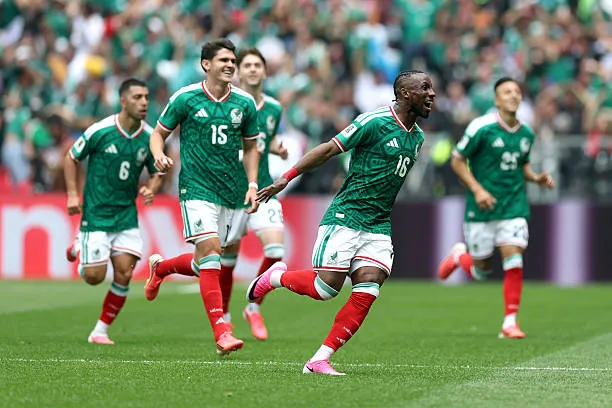
Julian Quinones scored the opener in the first half. Raul Jimenez headed in the second in the 67th minute. In between and around those two moments, the match descended into a chaos that Mexico controlled and South Africa contributed to. The scoreline reads 2-0. The story is considerably more complicated than that.
How the Goals Came
Mexico took the lead through Quinones. The Colombian-born winger, who has spent his career fighting for acceptance as a genuine El Tri player after choosing Mexico over Colombia, scored the kind of goal that ends those conversations. Receiving the ball in the area, he turned and finished with composure in front of 80,000 people who had been waiting for exactly that moment. Erik Lira provided the assist. The goal was deserved. Mexico had been the better side and the Azteca had the release it needed.
Jimenez added the second in the 67th minute. A cross from the right, a run to the back post, and a headed finish that the 35-year-old has been dreaming about for years. Jimenez suffered a catastrophic skull fracture at Arsenal in 2020 that nearly killed him. He has played international football since, but had never scored at a World Cup. When the ball hit the net he broke down on the pitch. The crowd was already on its feet. It was, in the middle of a chaotic, fractious match, a genuinely human moment.
The Red Cards: What Happened and When
Three red cards. Three different situations. Three different lessons.
Sphephelo Sithole went first, in the 49th minute. A foul on Brian Gutierrez who was running through on goal. It was a clear red card by the laws of the game. Denial of an obvious goalscoring opportunity, the contact deliberate enough that there was no argument. The VAR reviewed it briefly and confirmed the decision. Sithole will now miss South Africa's next match against South Korea. A player who started the World Cup will end his group stage participation having played 49 minutes.
Themba Zwane went second. He had come on as a substitute, replacing Jayden Adams as Broos tried to change the game. Minutes after entering the pitch, Zwane caught his opponent Alvarado in the face with his hand off the ball. VAR reviewed it and upgraded the challenge to a red. It was needless. Reckless in the precise way that a team that is already losing and already down to ten men cannot afford. Zwane will also miss the next match. South Africa finished the game with nine men.
Cesar Montes went last, for Mexico. Late in the match, with South Africa down to nine and the game already settled, Montes committed a full-body tackle on Khuliso Mudau as he ran toward goal. Brazilian referee Wilton Sampaio produced the red card after very little hesitation, though the crowd booed the decision heavily. Mexico finished with ten. South Africa with nine. It was, as the FOX broadcast confirmed, the first opening match in World Cup history to produce three red cards.
Eight Things This Match Taught Us
1. Sithole's red card may have decided the group stage for South Africa
The 49th-minute sending off changed this match completely. South Africa had spent large stretches of the first half competitive. The mid-block that Broos had set up was functioning. Mexico had the lead but had not been dominant enough to make the result feel settled. Then Sithole fouled Gutierrez, VAR confirmed it, and the tactical plan collapsed. You cannot defend a mid-block with ten men against a team of Mexico's quality in an Azteca at altitude for 40 minutes. It is not possible. South Africa's chance of getting anything from this match ended in that moment. The broader problem is that Sithole, now suspended, misses South Korea. Broos has lost a key defensive option for the match South Africa must not lose.
2. VAR is going to define this World Cup and not always fairly
Three of the most significant moments in this match involved VAR. Sithole's red was correct. Montes's red was defensible but felt harsh given the game was already decided and the tackle came in open play. Zwane's red was correct on the letter of the law but raises questions about whether VAR's involvement in a match already decided is the right use of the technology. There will be arguments across the tournament about whether VAR is protecting players or removing the human element from officiating. This match started those arguments on day one. Expect them to continue.
3. Quinones answered every question about his eligibility in one touch
The debate about whether Colombian-born players who choose Mexico are authentically El Tri has followed Quinones since his international debut in 2023. He scored the first goal of the 2026 World Cup on Mexican soil. The argument is over. What the goal also demonstrated was his movement in the area and his composure in front of a crowd that was carrying its own anxiety about the result. He could be the breakout player of this tournament for Mexico if Aguirre continues to give him the platform this performance earned.
4. Jimenez's goal was the moment of the match and it was not close
Football occasionally produces the story it should rather than the story that seems likely. In November 2020, during a Premier League match between Wolverhampton Wanderers and Arsenal, Jimenez collided with David Luiz and suffered a depressed skull fracture. He was stretchered off the Emirates and operated on that same night. There were genuine questions in the weeks and months that followed about whether he would play football again at any level, let alone at a World Cup. His goal output for Mexico had dried up in the years since, the kind of drought that a fractured skull and the anxiety that surrounds a return to contact sport can explain without much analysis.
He returned. He kept going. He moved from Wolves to Fulham and recently signed back with Wolves despite their relegation to the Championship. Coming into this tournament he had 45 goals for Mexico in 124 appearances, sitting third on El Tri's all-time scoring list, one behind the legendary Jared Borgetti's mark of 46.
The headed finish in the 67th minute was his first ever goal at a World Cup across four tournaments spanning 2014, 2018, 2022 and now 2026. It was also his 46th international goal, drawing him level with Borgetti and placing him joint second on Mexico's all-time scoring list behind only Javier Hernandez's 52. He broke down on the pitch. The stadium was already on its feet. Whatever else happens at this World Cup, that image is the one that will be used to describe the opening day. The man who nearly died playing football, scoring the goal that had eluded him for a decade, in their home stadium, at the tournament Mexico has waited 40 years to host again.
5. Zwane's red was inexcusable and Broos has to ask difficult questions about his squad's discipline
Hugo Broos brought Zwane on to change the game. Within minutes of entering the pitch, Zwane had raised his hand into the face of an opponent and given VAR exactly the footage it needed to send him off. This was not a foul made in the heat of a challenge. It was an off-the-ball incident in the 80th minute of a match South Africa were already losing heavily. There is no tactical or competitive explanation for it. A nine-man South Africa has no chance of scoring against Mexico. A ten-man South Africa had a small but genuine chance of conceding fewer goals and protecting their goal difference for the rest of the group stage. Zwane removed even that possibility.
6. South Africa's group stage survival depends entirely on what happens against South Korea
With eight of the twelve third-place teams advancing from the group stage in the expanded format, South Africa are not mathematically eliminated after one defeat. But the calculations are now tight. They need at minimum a draw against South Korea in their second match. Likely a win. A loss would leave them needing a significant victory over Czechia in the final group game with qualification odds already significantly reduced. Broos will name his next starting lineup without Sithole and Zwane. The squad depth in defensive positions will be tested. The margin for further error is gone.
7. Mexico's altitude preparation made a visible difference in the second half
Broos prepared for the Azteca's altitude by basing the squad at Pachuca for ten days before the match. It was not enough. In the second half, with ten men, the South African players visibly tired faster than their opponents. Mexico's substitutes, including 17-year-old Gilberto Mora, who became the youngest player in El Tri history at a World Cup, came on with energy that the Bafana players could not match. The physical gap that 2,240 metres of altitude creates in the legs of players who have not lived and trained there is not a preparation problem. It is a structural disadvantage for every visiting team Mexico will face at home.
8. The first World Cup opening match with three red cards said more about the tournament's tensions than the football
This was a fractious match. The yellow cards accumulated from early. The fouls were frequent. South African frustration, visible in Sibisi's elbow on Quinones that earned another yellow late in the game, reflected a team that felt the match slipping away and could not find a constructive response. None of that is unusual in tournament football. What is unusual is three red cards in the opening match of the tournament, all of them involving VAR review, all of them reflecting the kind of edge that comes when a team at a major tournament for the first time in 16 years encounters a home crowd of 80,000 and a ruthless opponent in the first 90 minutes. The Azteca does not forgive mistakes. South Africa made too many.
Where Bafana Go From Here
The expanded format is a lifeline. South Africa are not out. But the path to the round of 32 just got significantly narrower. Two suspended players. A goal difference of minus two from the opening match. A match against South Korea next that now feels closer to a must-win than a should-win.
Broos said before the tournament that his team had nothing to lose and that the Azteca was a match to enjoy. The players gave everything they had in what turned out to be an occasion far too large and far too hostile for what the squad was prepared to manage. That is not a failure of effort. It is a consequence of being a relatively inexperienced side, at altitude, in the most intimidating stadium in world football, in your first World Cup in 16 years.
The tournament is not over. But it is no longer forgiving.
Result: Mexico 2-0 South Africa Goals: Quinones (first half), Jimenez (67') Red cards: Sithole (49', South Africa), Zwane (VAR, South Africa), Montes (Mexico) Venue: Estadio Azteca, Mexico City Competition: 2026 FIFA World Cup, Group A, Matchday 1
Follow Sport Blot for coverage of South Africa vs South Korea and every Group A development at the 2026 World Cup.