
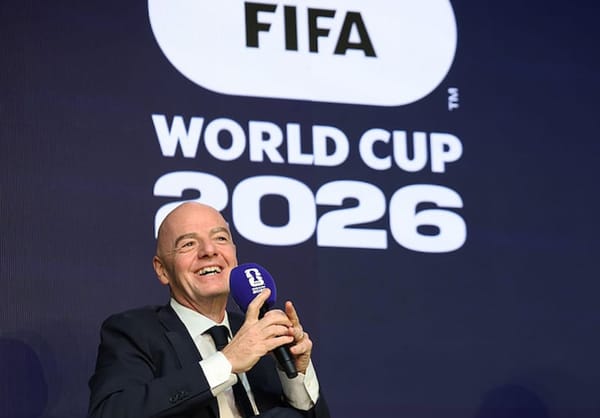

When the 2026 FIFA World Cup kicks off across the United States, Canada, and Mexico, African football will not only be chasing global glory — it will also be competing in the most financially rewarding tournament in international football history. For the first time ever, the competition will feature 48 teams and 104 matches, dramatically expanding opportunities for nations across the world. Financial figures released by FIFA show that a record $727 million has been allocated to participating teams, making the 2026 tournament the most lucrative World Cup ever staged.
The scale of the prize fund highlights how the global game is evolving economically. For African teams preparing to compete on football's biggest stage, the financial rewards could reshape national football programs for years to come.
The expansion from 32 teams to 48 means that nine African nations will qualify directly for the World Cup. Under the current qualification format organized by the Confederation of African Football, the nine group winners in Africa's qualifying campaign will automatically secure their places at the tournament, while a potential tenth nation could still reach the competition through an intercontinental playoff pathway established by FIFA.
This represents the largest African presence in World Cup history. Traditional continental powers — including Morocco, Senegal, Egypt, Algeria, Ghana, Tunisia, Ivory Coast, South Africa, and Cape Verde — are among the countries expected to compete for qualification during a demanding campaign.
The expanded format is expected to increase Africa's chances of progressing deeper into the tournament while allowing more national associations to benefit from the World Cup's record financial distribution.
Guaranteed Earnings for Every African Team
Even before a single ball is kicked, every team participating in the tournament will receive guaranteed financial compensation.
According to the official FIFA Council financial report released on 17 December 2025, each qualified nation will receive $1.5 million as a preparation grant, ensuring that all participating teams have funding ahead of the competition. When combined with the minimum prize allocation, every participating country is guaranteed at least $10.5 million simply for taking part in the tournament.
Speaking in the official FIFA Council statement, FIFA President Gianni Infantino addressed the significance of the financial expansion:
"The FIFA World Cup 2026 will also be groundbreaking in terms of its financial contribution to the global football community."
For African football federations that often operate with limited budgets, that guaranteed injection could fund infrastructure projects, youth academies, and domestic league improvements for years after the tournament concludes.
How Prize Money Increases Through Each Stage
The financial rewards escalate dramatically as teams progress deeper into the competition. According to FIFA's official prize money schedule, teams eliminated in the group stage will earn $9 million, while those reaching the Round of 32 will earn $11 million. Teams advancing to the Round of 16 are set to receive $15 million, and quarter-finalists will collect $19 million.
Of the $727 million total prize fund, $655 million is allocated as competitive prize money, with the remainder covering preparation grants.
For African nations that traditionally aim to reach the knockout stages, these figures represent transformational revenue — the kind that can fund a generation of development rather than a single season.
The Massive Reward for World Cup Glory
The ultimate financial reward awaits the team that lifts the trophy. According to FIFA's official financial distribution report, the winners of the 2026 FIFA World Cup will receive a record $50 million in prize money. The runners-up will collect $33 million, while the third-place team will earn $29 million and the fourth-place side will receive $27 million.
According to reporting by BBC Sport, the $727 million prize fund represents a 50 percent increase in World Cup prize money compared with the 2022 tournament in Qatar, which distributed $440 million. Writing in DAZN's analysis of the 2026 prize structure, journalist Rudi Schuller captured the scale of the shift, noting that "a grand total of $727 million USD has been set aside by FIFA for the participating nations of next summer's competition."
The jump in prize money reflects the growing commercial value of the World Cup and the global demand for football's most prestigious tournament.
Record Revenue and Global Investment
The financial expansion surrounding the 2026 World Cup is part of a broader economic strategy within global football. FIFA has confirmed that the tournament will feature a record financial distribution as part of its wider revenue cycle for the 2023–2026 period.
The expanded distribution reflects the growing commercial value of the competition as the tournament scales to 48 teams and 104 matches. For African football, these financial distributions extend beyond the national teams themselves. Many players representing African countries compete in European leagues, meaning clubs, federations, and grassroots development structures can all benefit indirectly from the tournament's economic impact.
What These Earnings Could Mean for African Football
For African nations, the financial rewards associated with the 2026 World Cup could prove transformative. Under the financial structure approved by FIFA, every qualified nation will receive at least $10.5 million when preparation grants and minimum prize money are combined.
For many African federations, that figure represents a significant share of their annual football budgets. In several countries, national associations operate with far smaller financial resources than major European federations, meaning World Cup income can directly influence development programs, infrastructure projects, and long-term planning.
One example frequently highlighted by analysts is the Royal Moroccan Football Federation. Morocco has spent years investing in football infrastructure and youth development systems, including the Mohammed VI Football Academy. According to a report published by the Confederation of African Football, the academy has produced numerous national team players and is widely regarded as one of the continent's most influential talent development institutions. Morocco's historic run to the semi-finals of the 2022 FIFA World Cup demonstrated how that long-term investment can translate into results on the global stage.
However, the impact of World Cup revenue has not always been consistent across the continent. Some federations have faced criticism over governance and financial management, with development funds not always translating into improved domestic leagues or grassroots programs. That contrast sharpens the stakes for African football as the 2026 tournament approaches.
If managed effectively, the guaranteed millions from World Cup participation could strengthen youth academies, support women's football programs, improve stadium infrastructure, and expand coaching education across the continent. With Africa set to have its largest representation ever at the 2026 FIFA World Cup, the financial rewards could shape the future of the game far beyond the tournament itself.
Related News
Football, Politics, and the African Coaching Carousel: The Story Behind Rhulani Mokwena’s Algiers Arrest
Mar 31, 2026
AFCON Controversy: Senegal’s CAS Appeal and the Role of Football’s Highest Court
Mar 28, 2026
FIFA Rules and African Football 2026: How Key Laws Could Decide World Cup Matches
Mar 23, 2026