Table of Contents
The award was announced on December 24, 1995. France Football's Ballon d'Or, the most prestigious individual prize in football, went to a man from Clara Town, one of the poorest slums in Monrovia, the capital of a West African nation that most of the award's previous winners could not have located on a map. George Tawlon Manneh Oppong Ousman Weah, known to football as George Weah and to Liberia as King George, became the first African to win the Ballon d'Or. Thirty years later, he remains the only one. That fact, held alongside what African football has produced in the three decades since, is not a verdict on the quality of the continent's players. It is a verdict on the voting system's geography. Weah himself understood this when he accepted the award. He said he hoped he would not be the last. He is still waiting for company.
Clara Town and the Education of a Striker
Weah was born in 1966 into a country that was, by any measurement, one of the poorest on earth. Clara Town was not a neighbourhood in any comfortable sense of the word. It was a settlement of corrugated iron structures on the edge of Monrovia where families of minimal means lived densely and children played football because football cost nothing and required nothing beyond a ball or an approximation of one. Weah's grandmother, Emma Brown, raised him after his parents separated. He would later say that everything he became, he owed to her. He learned football on Clara Town's concrete surfaces, developing the close control and physical resilience that concrete pitches demand. He played for local clubs, Mighty Barolle and Invincible Eleven, two of Liberia's most established football institutions, before catching the attention of a scout who arranged a move to Cameroonian club Tonnerre Yaounde. He was still a teenager.
The Cameroon period was the bridge. Tonnerre Yaounde were a club of genuine continental ambition, and Weah's performances there attracted the notice of a coach who would become one of the most important figures in modern football history. Arsene Wenger was managing AS Monaco in 1988 when he signed Weah for a reported transfer fee of £12,000 — a number that would become one of the most discussed footnotes in football economics once the full arc of what followed became clear. Wenger saw in Weah a combination of physical gifts and technical quality that the French football market had not encountered in an African player before: pace, power, two-footedness, an instinct for goal that functioned equally in the open field and in tight spaces, and an ability to carry the ball from deep positions that would eventually produce the most celebrated moment of his career.
Paris: The Goal That Should Have Won Everything
Weah spent four years at AS Monaco before moving to Paris Saint-Germain in 1992. The PSG years are where his European reputation was built into something unignorable. He won Ligue 1. He won the Coupe de France and the Coupe de la Ligue. He scored 55 goals and provided 54 assists across 137 competitive appearances, numbers that place him among the most productive attacking midfielders or forwards the club has ever had. And in the 1994-95 Champions League campaign, he produced the moment that defines his PSG tenure in the collective memory of everyone who saw it.
PSG were playing AC Milan in the quarter-final second leg at the Parc des Princes. The score was level. Weah received the ball inside his own half, in a position where the sensible option was to retain possession and build. He ran instead. He took the ball past one defender, then another. He entered the Milan half without slowing. He ran past a third defender, then a fourth. He entered the penalty area and finished with a composure that made the entire sequence seem, in retrospect, planned. It was not planned. It was instinct operating at its highest possible intensity. The goal has been described by multiple football analysts as one of the greatest solo efforts in Champions League history. PSG went out of the tournament, but the goal survived the result by decades. It is still used as the definitive illustration of what Weah could do when the moment and the space aligned.
Milan and the Ballon d'Or
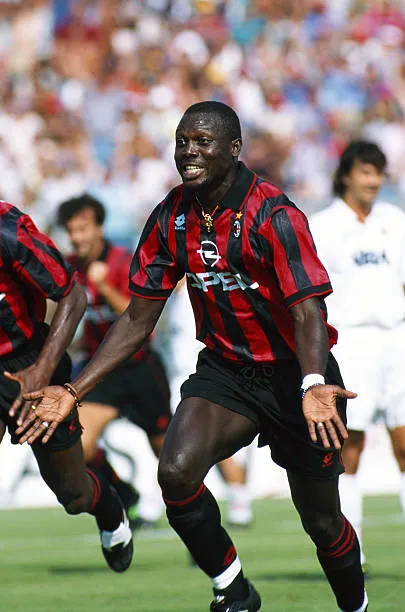
AC Milan signed Weah in the summer of 1995 for a fee that represented a significant marker for African football. He won the Serie A title in his first full season. He won it again in 1999. In his five years at Milan, he scored goals at a rate consistent with the great forwards of his era, filled the attacking void left by Marco van Basten's retirement, and became the central figure of a club that regarded itself as one of the two most prestigious in world football. In his first year at Milan, while still finishing his PSG obligations and transitioning to Italian football, he produced the body of work that France Football judged, in December 1995, to be the finest by any individual player on earth.
The Ballon d'Or that year was awarded on the basis of performances at club level across the calendar year. Weah had scored eight goals in the Champions League for PSG, including that quarter-final solo effort. He had scored eleven goals in 26 Serie A appearances in his first partial season at Milan. The FIFA World Player of the Year award, voted on by international coaches and captains, also went to Weah that year. He won both. He remains, thirty years later, the only African player to have done so. He was named African Footballer of the Year three times across his career, in 1989, 1994 and 1995. The continental award confirmed what the global ones stated: within Africa, the verdict on who was best was not contested.
Liberia and the Weight He Carried Alone
The dimension of Weah's career that no statistical breakdown fully captures is what he did for and as the Liberian national team. Liberia are not a major football nation. They have not qualified for a World Cup. During Weah's playing career, they had almost no institutional support, no functioning federation budget of any reliability, and no realistic pathway to the tournaments where Weah was becoming one of the best players in the world. He played 61 international matches for the Lone Star, scoring approximately 22 goals, across a career in which his club appearances were placing him at the very summit of the game. He paid for the national team's travel costs, accommodation and equipment out of his own salary on multiple occasions. He trained them. He organised friendlies. He attempted, through the sheer force of his individual presence, to drag a football programme into a position where the continent might notice it.
Liberia never qualified for a World Cup during his career, or after it. That fact is sometimes presented as a failure. It is more accurately presented as a context. Weah was the Liberian national team in the way that one person cannot be an entire national programme. He carried everything available to him as far as it would go. The rest required infrastructure, investment and stability that Liberia, a country that endured two civil wars between 1989 and 2003, simply did not have. He kept playing for the Lone Star through both conflicts, kept paying for their participation when no institution would, and kept showing up in a green shirt at qualification campaigns where the outcome was never in serious doubt. The commitment was not strategic. It was loyalty, and it cost him considerably in terms of the injury risk and physical wear that international duty adds to a career.
Chelsea, Retirement and the Path to the Presidency
Weah left Milan in 2000, had a brief loan at Chelsea where he scored in the FA Cup, spent time at Manchester City and Marseille, and retired from club football in 2003 after a final spell at Al Jazira in the UAE. He was 36. He had scored 193 career club goals. By the time he stopped playing, the first Liberian civil war had ended, the second had ended, and his country was in the early stages of a reconstruction that needed, in addition to everything else, a political class that Liberians could trust. Weah had funded schools and youth football programmes throughout his playing career through personal outreach rather than institutional charity. He was already, in Liberia, not a footballer but a national figure.
He ran for President in 2005 and lost narrowly to Ellen Johnson Sirleaf, who became the first female head of state in African history and later won the Nobel Peace Prize. He was elected to the Liberian Senate in 2014. He ran for President again in 2017 and won. On January 22, 2018, George Weah was inaugurated as the 25th President of Liberia. He governed until 2024, losing a second-term bid but remaining one of the most recognisable political figures in West Africa. He is the only person in history to have won the Ballon d'Or and led a nation as head of state.
What He Left Behind
The question of Africa's greatest footballer does not have a clean answer. Didier Drogba won more trophies. Samuel Eto'o scored more goals at the highest level across a longer peak. Jay-Jay Okocha produced more moments of individual brilliance in a single viewing. Yaya Toure controlled more Champions League midfields. The argument is genuine and it runs in multiple directions depending on what criteria the conversation values. What Weah did that none of the others did is win the Ballon d'Or. He won the FIFA World Player of the Year. He won the absolute top prize, by the universal standard of his era, in competition with every player on earth. He was, in 1995, officially the best.
He grew up in a Monrovia slum. He was signed by Arsene Wenger for £12,000. He scored one of the great Champions League goals in a match his team lost. He paid for his own national team to travel to qualification campaigns. He won Serie A twice. He became President of a country. The Ballon d'Or he won in 1995 sits in Liberian national consciousness not as a sporting trophy but as a statement about what the continent is capable of producing. Thirty years on, Africa has produced Salah, Mane, Mahrez, Osimhen, Hakimi, Nkunku, and a generation of players whose individual quality matches anything the game has seen. None of them has won the Ballon d'Or. King George remains alone in that room. He always said he hoped he would not be. He is still waiting for company.