
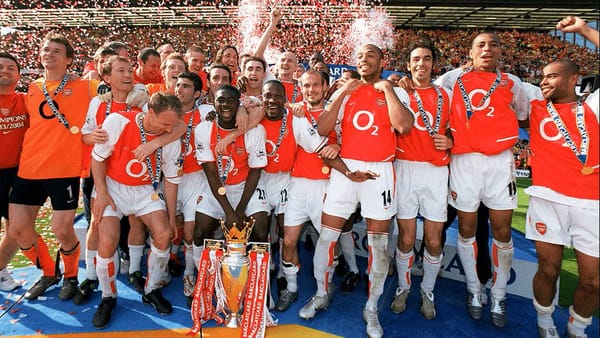

After the sensesational 2-0 win against Everton over the weekend, and Manchester City held to a draw by the hammers at the London stadium, Arsenal are nine points clear at the top of the Premier League with seven games remaining.
The Opta supercomputer gives them a 90-plus percent chance of winning the title. For the first time since the Invincibles season of 2003–04, the trophy is genuinely coming to the Emirates. It is not a question of if. It is a question of when.
And when it happens, somewhere in Africa, a city is going to erupt.
This is not a casual observation. Arsenal are not merely popular in Africa — they are the most supported club across East and North Africa, with BBC research identifying them as the dominant club in Nigeria, Kenya, Uganda, Tanzania, Ethiopia, Algeria, Morocco, Tunisia, and Malawi. The club's official 'Fans From Afar' programme lists African nations prominently, and Arsenal officially recognises supporters' clubs across ten African countries. The fanbase is enormous, passionate, and it has been waiting over two decades for this moment.
So which African country goes craziest when the title is confirmed? We've made the case for five contenders — and then given you our verdict.
Nigeria — The Favourite
Nigeria is, by almost any measure, Arsenal's largest African fanbase. Social media data consistently ranks Nigerian Arsenal supporters as the single biggest international contingent outside England. The country's connection to the club is deep and historical: Nwankwo Kanu won two FA Cups in a red and white shirt and is still spoken of with reverence in Lagos and Abuja. Alex Iwobi came through the Arsenal academy and represented the club for years. And then there is the current subplot that every Nigerian football fan is tracking.
Ethan Nwaneri — Arsenal's teenage prodigy, born in London to an Igbo Nigerian father — is currently on loan at Marseille. In February 2026, when asked about former Nigerian internationals Taye Taiwo and Wilson Oruma who had played for the club, Nwaneri's response was immediate. "Yes, I know. I'm Nigerian, and I am here to help the team as much as possible," he told R.org. The Super Eagles head coach has since made contact with the player's representatives. Nigeria has not yet won him, but they are trying.
Arsenal winning the league while a Nigerian-heritage teenager is their most-talked-about young player is not a footnote for Nigerian fans — it is the full story.
Add to that the raw numbers. Nigeria is a country of over 220 million people where Premier League football dominates public conversation every weekend. When Arsenal's title is confirmed, the watch parties, the street celebrations, the social media noise from Nigeria alone will be difficult to match anywhere else on the continent. If volume is the measure, Nigeria wins this contest without a debate.
Kenya — The Emotional Heart
Kenyan Arsenal supporters have a reputation that extends well beyond the country's borders. When BBC Twitter research mapped the most-supported club by country, Kenya was Arsenal's — firmly and without competition. The club's Kenyan fanbase is not just large; it is organised, vocal, and deeply emotionally invested in a way that produces genuinely spectacular scenes when Arsenal win anything significant.
This is a country that has produced some of the most-shared Arsenal celebration videos in African football history. Watch parties in Nairobi regularly fill large venues. When Arsenal beat Tottenham 4–1 in November 2025 — a result involving Noni Madueke, a player of Nigerian descent — the scenes from Kenyan fan bars went internationally viral within hours.
Kenya's case is not about having the biggest fanbase in raw numbers. It is about intensity per supporter. The Kenyan Arsenal fan does not merely watch the game — they live it. An Arsenal title, the first in 22 years, would produce celebrations in Nairobi that this city would not recover from quickly.
Uganda — The Wildcard
Uganda's football culture has a specific characteristic that makes it relevant to this conversation: it is dominated, to an unusual degree, by English Premier League allegiances rather than domestic football. And within those EPL allegiances, Arsenal and Manchester United account for the overwhelming majority of supporters. In Uganda, supporting Arsenal is less a hobby and more an identity — passed from father to child, embedded in neighbourhoods, debated in offices.
The Uganda Arsenal Supporters Club is one of the more active on the continent. When Arsenal have had good runs in recent seasons, Ugandan social media responds loudly and disproportionately relative to the country's size. An actual title — the first in a generation — would produce scenes in Kampala that the city has rarely seen for a foreign club. The intensity of Ugandan Arsenal support, compressed into a population that cares deeply about this particular club, makes Uganda a genuine wildcard for the most spectacular single-city celebration.
Algeria & North Africa — The Sleeping Giant
Arsenal's dominance in North Africa is less discussed than their West or East African presence, but it is structurally significant. The BBC's research placed Arsenal as the most popular club in Algeria, Morocco, and Tunisia. Algeria alone has a population of 46 million people, with a football culture that is saturated with French league football and, through canal and satellite television, the Premier League.
The North African Arsenal fanbase has a particular characteristic: it skews younger and is heavily digital. The social media response from Algeria, Morocco, and Tunisia when Arsenal win significant matches has become increasingly visible over the past three seasons. A title confirmation — especially if it comes dramatically, in a late match or a final-day scenario — would produce an online explosion from the Maghreb that rivals anything from sub-Saharan Africa.
What North Africa lacks in street-party spectacle it makes up for in sheer digital reach. And in 2026, where a celebration is amplified online matters as much as where it happens physically.
Ethiopia — The Underrated Contender
Ethiopia does not always feature in conversations about Arsenal's African fanbase, but the BBC data placed it firmly in Arsenal territory. With a population of over 120 million people, a rapidly growing urban middle class, and a football culture that has embraced Premier League football with increasing passion over the past decade, Ethiopia represents one of the continent's most significant untapped stories in the Arsenal fanbase narrative.
Addis Ababa, a city of five million people with a young, connected population, has the infrastructure for spectacular celebrations. And the Ethiopian Arsenal community — quieter than Nigeria's, less internationally visible than Kenya's — has been waiting for this moment for exactly as long as everyone else. When it arrives, the surprise might be how loud Addis Ababa gets.
The Verdict: Nigeria Celebrates, But Kenya Feels It Most
If the question is which African country produces the most noise, the most content, the most sheer volume of celebration — Nigeria wins. The numbers are too large, the history too deep, the current Nwaneri subplot too perfectly timed. Lagos will be a carnival. Abuja will be a carnival. The Nigerian internet will be unusable for a weekend.
But if the question is which African country will feel it most deeply — which country will experience the Arsenal title as something close to a personal, communal, almost sacred event — the answer is Kenya. The Kenyan Arsenal supporter has a particular kind of devotion that transcends casual fandom. They have grieved Arsenal's near-misses harder than most. They have waited longer, in emotional terms, than the fanbase's size would suggest.
Nigeria will throw the biggest party. Kenya will cry the happiest tears.
Either way, the 2025–26 Premier League season is about to hand African football culture something it has been building toward for 22 years. The last time Arsenal were champions, most of their current African supporters were children — if they had been born at all. This title belongs to a generation that has known nothing but the wait.
The wait, according to every available piece of evidence, is nearly over.
Related News
Football, Politics, and the African Coaching Carousel: The Story Behind Rhulani Mokwena’s Algiers Arrest
Mar 31, 2026
AFCON Controversy: Senegal’s CAS Appeal and the Role of Football’s Highest Court
Mar 28, 2026
FIFA Rules and African Football 2026: How Key Laws Could Decide World Cup Matches
Mar 23, 2026