
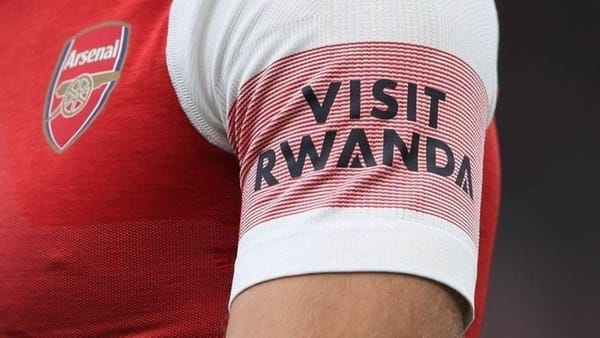

When Arsenal players stepped onto the pitch at the Emirates Stadium during the opening weeks of the 2018–19 Premier League season, fans quickly noticed something new stitched onto the left sleeve of the famous red and white shirt. Just below the Premier League badge sat a small but striking message: “Visit Rwanda.”
For many supporters inside the 60,000-seat Emirates Stadium, the logo looked like another routine sponsorship in modern football, a sport where clubs generate millions through commercial partnerships. Arsenal had already built a global business model around sponsorships such as Fly Emirates, Adidas, and other corporate partners.
But the Visit Rwanda message was different.
Instead of promoting a multinational company, the sleeve patch promoted an entire country. The partnership was designed to market Rwanda as a global tourism destination to the hundreds of millions of viewers who watch Arsenal matches every season across Europe, Africa, Asia, and the Americas.
Within months, the deal had become one of the most discussed sponsorships in the Premier League. Some supporters viewed it as an innovative tourism campaign that connected African development with the global reach of football. Others argued that the agreement raised difficult political questions about government involvement in sport.
Over the next eight years, the partnership between Arsenal Football Club and the Rwanda Development Board evolved far beyond a standard marketing arrangement. What began as a tourism promotion strategy eventually became a focal point for debates about sports diplomacy, human rights criticism, fan activism, and the growing influence of African governments in global football sponsorship.
The Birth of a Unique Sponsorship
The partnership officially began in May 2018 when Rwanda signed a tourism promotion agreement with Arsenal. According to reporting by BBC Sport and Reuters, the deal was valued at approximately £10 million per year, which equals roughly 13 million US dollars annually.
The agreement made Visit Rwanda the first official sleeve sponsor in Arsenal’s history. The logo appeared on the left sleeve of shirts worn by the club’s men’s team, women’s team, and academy sides, ensuring the branding appeared in domestic competitions, European matches, and global broadcasts.
At the time, sleeve sponsorship was a relatively new commercial opportunity in English football. The Premier League introduced sleeve sponsorship rights in the 2017–18 season, allowing clubs to sell additional branding space on match kits.
The initial contract between Arsenal and the Rwanda Development Board was structured as a three-year agreement running from 2018 to 2021. However, the partnership proved commercially successful and was later extended.
According to The Athletic, SportsPro Media, and The EastAfrican, the deal eventually ran until the 2025–26 season, bringing the estimated total value of the partnership to more than £80 million, which is approximately 100 million US dollars across the life of the contract.
For Arsenal, the agreement represented a significant commercial boost during a period when the club was rebuilding on the pitch after the departure of legendary manager Arsène Wenger in 2018. For Rwanda, the partnership offered access to one of football’s largest global audiences.
Marketing a Nation Through Football
The concept behind the deal was part of a broader strategy sometimes called “nation branding.” Rather than promoting a specific company, the sponsorship promoted a country itself. Rwanda’s Visit Rwanda deal exemplifies a broader nation branding strategy, where countries leverage sports sponsorship to shape global perception and attract investment. Similar approaches have been seen in other nations, such as Saudi Arabia’s partnerships with European football clubs and Qatar’s investment in sports events, showing that Rwanda’s move is part of a growing trend of countries using high-profile sports deals to enhance their international profile.
Arsenal, one of the most globally recognized clubs in football, provided enormous exposure. Their matches are broadcast worldwide to millions of viewers, and the sleeve logo was visible in television coverage, social media posts, and highlight reels.
Beyond the branding, the partnership also included a number of promotional initiatives. Arsenal players and club legends travelled to Rwanda for promotional tours, while club coaches organized football development camps for young players in the country.
According to data from the Rwanda Development Board’s 2024 Annual Report, tourism in Rwanda grew significantly during the partnership period. The country recorded around 1.3 million tourists in 2024. This generated approximately $650 million in revenue, a 47 percent increase since 2018.
Rwanda officials credited the Arsenal deal with raising international awareness of the country as a travel destination.
“This partnership broke new ground for tourism boards around the world,” Rwanda Development Board CEO Jean-Guy Afrika said in a statement reported by BusinessDay in November 2025.
Controversy and Criticism
Despite its commercial success, the partnership quickly became controversial.
Human rights groups, including Human Rights Watch and Amnesty International, highlighted concerns over Rwanda's governance and its involvement in regional conflicts. Reports have pointed to alleged political repression within Rwanda and its role in tensions in the Democratic Republic of Congo, citing issues such as suppression of political opposition and restrictions on freedom of assembly and press.
The Congolese government publicly criticized Rwanda’s international sports sponsorships. In a statement reported by SportsPro Media, DR Congo foreign minister Thérèse Kayikwamba Wagner urged European clubs to reconsider their agreements with Rwanda.
She said the sponsorships risked ignoring serious regional tensions.
“European football clubs should question whether they want their global platforms associated with sponsorships that ignore the ongoing suffering in eastern Congo,” Wagner said in comments reported by SportsPro.
Criticism also emerged within the Arsenal fan community.
In April 2025, the supporter group Gunners for Peace organized a high-profile demonstration at the Emirates Stadium during Arsenal's Champions League semi-final first leg against Paris Saint-Germain (PSG) on April 29, 2025. Protesters carried banners calling on the club to reconsider the partnership and staged a satirical campaign by placing a “Visit Tottenham” billboard near the stadium. The message mocked the sponsorship by referencing Arsenal’s North London rivals.
Fan organizations also conducted surveys showing significant opposition to the deal. According to The Athletic, a survey by the Arsenal Supporters’ Trust found that more than 90 percent of respondents supported ending the partnership.
Some supporters also raised concerns about Rwanda’s record on LGBTQ+ rights, prompting criticism from Gay Gooners, the club’s LGBTQ+ supporters group.
The End of the Partnership
After years of debate, Arsenal confirmed in November 2025 that the club and the Rwanda Development Board had mutually agreed to end the partnership at the conclusion of the 2025–26 season.
The announcement marked the end of an eight-year relationship that had generated both marketing success and controversy.
Arsenal chief executive Richard Garlick reflected on the partnership’s achievements when the decision was announced.
“Our first-ever sleeve partnership with Visit Rwanda has been a significant journey,” Garlick said in comments reported by Sky Sports. “Over many years, we’ve worked together to raise global awareness of Rwanda’s tourism and conservation efforts and built many new connections with our supporters across Africa.”
During the height of the 2025 protests and criticism from the Congolese government, Arsenal issued a statement defending its Visit Rwanda partnership, emphasizing that the collaboration aimed to boost tourism and economic development, while noting that the club does not engage in political matters. As reported by Sky Sports and SportsPro Media in April 2025, club spokespeople said the sponsorship ‘reflects a shared goal of promoting sports and tourism, not endorsing political positions.’
The club has since secured a new sleeve sponsorship agreement with global payroll platform Deel, which will replace Visit Rwanda starting in the 2026–27 season.
A Legacy Beyond Football
Although the partnership is ending, the Visit Rwanda deal left a significant impact on the business of sport. Financially, it showed how clubs can generate major revenue through sleeve sponsorships. It also demonstrated how football can intersect with diplomacy, international relations, and national branding. For Rwanda, the partnership greatly increased global visibility for its tourism industry.
For Arsenal, it provided valuable income during a period of rebuilding. However, the controversy surrounding the deal also highlighted the growing scrutiny of sponsorships involving governments.
Ultimately, the Visit Rwanda–Arsenal partnership became more than a marketing campaign, illustrating how football’s global influence can shape tourism, politics, and public debate.
Related News
Six VAR Controversies That Shaped African Football
Mar 08, 2026
Unforgettable Key Moments in the Dramatic AFCON 2025 Final
Jan 19, 2026
Top African Football Commentators in 2025
Aug 14, 2025