

In football, the spotlight usually falls on the players, the coaches, and the goals that ignite stadiums across Africa. Yet one crucial piece of technology silently influences every match: the football itself. From the local academy pitch in Accra to the Africa Cup of Nations final, the design and manufacturing of match balls directly affects the speed, flight, and control of the game, as reported by CAF Online.
Modern match balls are no longer simple stitched leather spheres. Today they are advanced sporting equipment developed through aerodynamics research, new materials, and digital technology. Global sports manufacturers now design match balls using complex engineering techniques that influence how the ball moves through the air, how it reacts on different playing surfaces, and how accurately referees can monitor key moments during matches.
These technological innovations are increasingly shaping the way football is played and officiated at the highest level. With nine African teams expected to qualify for the expanded 2026 FIFA World Cup, players from the continent will compete using some of the most technologically advanced match equipment ever introduced in international football.
At the same time, Africa is witnessing a quiet shift. Local manufacturers are emerging, regional companies are expanding access to quality balls, and global brands continue to dominate the continent's biggest tournaments. Together, these trends show that the future of African football is not only about talent — it is also about who builds the ball itself.
Local African Manufacturers Emerging
Prostar and Justfit
Across the continent, local companies are beginning to challenge the dominance of imported match balls by producing equipment tailored to African leagues. Two notable examples are Nigeria's Prostar Sports and Tanzania's Justfit, both of which have recently secured important partnerships with domestic competitions, as reported by the Nigeria Premier Football League and Mwananchi Communications.
In January 2025, the Nigeria Premier Football League (NPFL) introduced match balls manufactured by Prostar Sports for the league's second half of the season. Details released by the NPFL show that the ball meets FIFA-regulated international match standards, featuring 32 panels, a weight of 400 to 430 grams, and a bounce range between 1.1 and 1.4 meters — specifications that place it within the same technical framework used by many global competitions.
Prostar CEO Paul Maduakor described the partnership's significance, explaining:
"This deal represents a major breakthrough for us at Prostar Sports... to produce and supply sporting equipment of international standard for the NPFL, the biggest league in Africa."
Similarly, Tanzania's sports brand Justfit unveiled a new match ball and referee kits for the Tanzanian Premier League in September 2025. Coverage from Mwananchi Communications highlighted that the move marked a major milestone, as the league had previously relied heavily on imported match balls. The emergence of local manufacturers has broader implications: it keeps production investment within African economies while allowing leagues to customise equipment for local conditions such as heat, humidity, and playing surfaces.
Sports Business Africa reported that these initiatives represent an important cultural shift — African football organisations are beginning to trust domestic engineering and manufacturing capabilities rather than defaulting to foreign products.
Growing Mid-Tier Manufacturers
Kipsta Expands Access to Quality Balls
While local brands are developing, mid-tier international manufacturers are helping expand access to high-quality match balls across the continent. One such company is Kipsta, the football equipment brand owned by French retailer Decathlon.
Although Kipsta balls are widely used in European leagues such as France's Ligue 1 and Ligue 2, their influence in Africa is growing through retail expansion and grassroots partnerships. In Ghana, Decathlon donated 1,000 Kipsta footballs to the Ghana Football Association's Women's Premier League, as reported by Sports24 Ghana. The initiative was part of a partnership designed to support women's football and improve training resources for clubs across the country.
Decathlon Ghana CEO Kwasi Tabury emphasised the company's guiding philosophy during the presentation:
"The accessibility of sports is of utmost importance to us."
That philosophy speaks to a critical reality for African football development: equipment availability matters. In many parts of the continent, grassroots academies struggle to secure reliable training balls, and contributions like these directly influence the quality of practice sessions, player development, and ultimately the competitiveness of the sport. For women's football in particular, the initiative signals growing recognition that infrastructure — including basic equipment — is essential for expanding participation.
Global Brands Dominating African Competitions
Puma and Adidas
Despite the rise of regional manufacturers, the biggest tournaments in African football are still dominated by global sportswear companies. According to reports from CAF Online and ESPN, Puma and Adidas continue to shape the technological standards used on the continent's biggest stages.
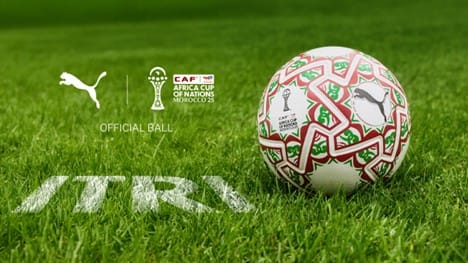
Puma currently serves as a major partner of the Confederation of African Football and produced the official match ball for the 2025 Africa Cup of Nations in Morocco, known as the 'ITRI.' According to ESPN's coverage of the unveiling, the ball combines traditional Moroccan artistic elements with modern performance technology inspired by the country's historic zellij mosaic art.
CAF Online explains that the design incorporates Puma's Orbita 6 technology, which meets elite competition standards while celebrating African culture through geometric patterns inspired by Moroccan craftsmanship. Star-shaped geometry symbolises ambition and excellence, while circular symmetry represents the 24 African nations competing in the tournament.
Puma executive Peter Dangl highlighted the meaning behind the design during the official launch. As reported by CAF Online, Dangl explained that the ITRI ball:
"...celebrates both the host nation's heritage and the unity of the continent."
The cultural significance of the collaboration was also articulated from the African football side. Speaking to ESPN, CAF Creative Development Manager Mohamed Ghonemi explained that the ball was "created for the rhythm of African football" — combining art, motion, and a design shaped by African spirit and Moroccan craftsmanship. According to Ghonemi, the project aimed to unite every nation participating in the tournament through a shared visual identity that reflects both tradition and innovation.
Adidas, meanwhile, remains the official match ball provider for the FIFA World Cup. According to the Adidas Newsroom, the 2026 'Trionda' ball introduces a four-panel construction and embedded Connected Ball Technology — a motion sensor chip that sends real-time data to the Video Assistant Referee system, helping referees identify touches of the ball more precisely and make faster decisions on offside calls and potential handball incidents.
Sam Handy, General Manager at Adidas Football, described the engineering ambition behind the design:
"With TRIONDA, every detail has an impact. The embossed textures, layered graphics and bold colours create a design built for the biggest stage."
According to FIFA, the 2026 World Cup will feature nine African nations qualifying directly for the tournament, hosted across the United States, Canada, and Mexico. Teams from the continent will compete using the Trionda ball throughout the competition, meaning African players will experience the same advanced match technology used at the highest level of international football.
The Future of Manufacturing: The "Made in West Africa" Initiative
While the technology behind football equipment continues to evolve, the geography of production may also change dramatically in the coming years. In 2026, FIFA announced the 'Made in West Africa' initiative — a project aimed at shifting the manufacturing of World Cup apparel and potentially sporting equipment toward African countries.
According to Foot Africa's 4 March 2026 report, part of the tournament's apparel production would be carried out in West African countries. The programme is designed to highlight regional cotton resources and strengthen textile industries in the region while integrating African countries more directly into the global supply chain surrounding the World Cup.
The implications for African football go far beyond economics. Currently, many match balls used worldwide are manufactured in Sialkot, Pakistan — a city responsible for producing a significant portion of the global football supply. If manufacturing expands into West Africa, it could create thousands of jobs while integrating the continent more deeply into the global sports equipment supply chain.
Experts suggest this would represent a full-circle transformation: African players competing on the world's biggest stage using equipment manufactured on African soil. It is a shift that would mirror the broader story this article tells — a continent no longer content to receive the ball, but increasingly determined to build it.
Related News
Football, Politics, and the African Coaching Carousel: The Story Behind Rhulani Mokwena’s Algiers Arrest
Mar 31, 2026
AFCON Controversy: Senegal’s CAS Appeal and the Role of Football’s Highest Court
Mar 28, 2026
FIFA Rules and African Football 2026: How Key Laws Could Decide World Cup Matches
Mar 23, 2026