

African football has long been celebrated for its flair, creativity, and attacking brilliance, yet history repeatedly shows that the continent's greatest achievements have been built on powerful defensive foundations. From Africa Cup of Nations triumphs to historic FIFA World Cup performances, elite centre-back partnerships have often provided the stability that allows teams to compete against the world's strongest opponents.
Defensive analysts frequently emphasise that the centre-back role goes far beyond simple tackling or clearing danger. In an analysis published on 13 May 2025, football data platform Sofascore described central defenders as "the pillars upon which defenses stand in any team," noting that their ability to read the game, dominate aerial duels, organise teammates, and maintain composure under pressure forms the backbone of a successful defensive unit. These qualities become even more powerful when two defenders develop chemistry as a partnership.
Modern tactical analysis also highlights how the role of centre-backs continues to evolve. According to a technical breakdown by ForPro published in December 2025, elite defenders today must combine traditional defensive skills with intelligence in possession — scanning the field and launching attacks from deep positions.
Across decades of African football, several centre-back duos embodied these qualities at the highest level. Their partnerships provided leadership, tactical discipline, and defensive authority that shaped major tournaments and defined some of the continent's most successful teams.
Here are five of the most dominant African centre-back partnerships of all time, ranked from fifth to first, whose chemistry and defensive command changed the course of matches and footballing history.
5. Kolo Touré & Sol Bamba — Ivory Coast's Physical Wall
Kolo Touré and Sol Bamba embodied the physical backbone of the Ivory Coast's 'Golden Generation,' combining Premier League experience with imposing strength. Touré, who had been part of Arsenal's famous 'Invincibles,' served as the organiser of the defence, using his pace, leadership, and ability to read the game to intercept danger and cover space behind the line. Alongside him, the 6'3" Bamba provided the raw physical presence — dominating aerial duels and confronting opposing strikers directly. Their partnership combined speed and intimidation: Bamba would engage attackers physically while Touré swept behind, ensuring defensive balance.
Their discipline was on full display against Portugal on 15 June 2010 at Nelson Mandela Bay Stadium in Port Elizabeth, when Ivory Coast drew 0–0 in the FIFA World Cup group stage. Reporting for Daily Maverick, Andy Rice noted:
"Kolo Touré was the more inspiring of the two captains, making several crucial tackles and rallying his defence."
That defensive effort — which helped restrict Cristiano Ronaldo and Portugal's attack to a handful of clear chances — highlighted the cohesion and courage that defined the Ivory Coast back line at its peak.
4. Uche Okechukwu & Taribo West — Nigeria's Fearless Enforcers
Uche Okechukwu and Taribo West formed the defensive backbone of Nigeria's Super Eagles during the 1990s, blending calm composure with aggressive physicality. Their partnership allowed stars like Jay-Jay Okocha and Nwankwo Kanu to flourish by ensuring defensive security at the other end. As reported by the Olympic Channel, Okechukwu — nicknamed 'The Gentle Giant' — excelled in positional intelligence and aerial strength, while West, known for his colourful braids and fearless style, brought relentless pace and aggression, often tasked with neutralising the opposition's most dangerous forwards.
Their most celebrated performance came on 3 August 1996 at Sanford Stadium in Atlanta, when Nigeria defeated Argentina 3–2 in the Olympic final. Argentina's attack applied constant pressure, yet Okechukwu and West combined physical strength, aerial dominance, and disciplined positioning to prevent the South Americans from extending their lead at critical moments. Their ability to read the game, win key tackles, and organise the defensive line allowed Nigeria to stay competitive long enough to mount a dramatic comeback and claim the gold medal — the first Olympic football title for an African nation.
The scale of the moment was captured immediately after the final whistle. Speaking to the Olympic Channel, midfielder Sunday Oliseh reflected:
"I guarantee you that as I talk to you now, everyone in Africa is celebrating. This is for all the African countries."
The duo proved their resilience again on 13 June 1998 at Stade de la Beaujoire in Nantes, when Nigeria stunned Spain 3–2 in the FIFA World Cup group stage. Okechukwu's yellow card while defending Spain's attacks underlined the physical commitment required to contain elite forwards — a commitment that helped deliver one of the tournament's most memorable upsets.
3. Lucas Radebe & Mark Fish — The Pillars of Bafana Bafana
Lucas Radebe and Mark Fish carried the emotional weight of South Africa's celebrated Class of '96, anchoring the team's defence with leadership and resolve. At a time when Bafana Bafana were re-emerging on the global stage after decades of isolation, the duo blended contrasting defensive qualities. Radebe — nicknamed 'The Chief' — anchored the backline with positional intelligence and aerial authority, while Fish provided mobility and ball-carrying ability from deep positions.
Their most defining performance came on 3 February 1996, when South Africa defeated Tunisia 2–0 in the Africa Cup of Nations final at Soccer City in front of nearly 80,000 supporters, securing the nation's first continental title. According to All Football, Radebe and Fish were described as 'rocks in defense,' with Radebe producing a crucial acrobatic clearance that helped preserve the clean sheet.
Fish later reflected on the significance of that day in an interview with All Football:
"What we had achieved, for the nation, was more than just football."
Their resilience was also tested on 24 April 1996, when South Africa narrowly lost 3–2 to Brazil in the Nelson Mandela Challenge at Soccer City. Bafana Bafana led 2–0 through goals from Phil Masinga (25') and Doctor Khumalo (42') before Brazil responded with strikes from Flávio Conceição, Rivaldo, and Bebeto. According to FootballDatabase, both Radebe and Fish received yellow cards during the intense defensive battle, highlighting how fiercely the duo fought to protect the backline against one of the world's most dangerous attacks.
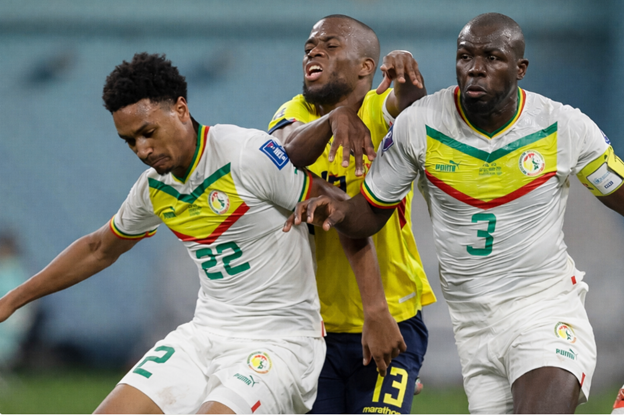
2. Kalidou Koulibaly & Abdou Diallo — Senegal's Modern Defensive Engine
At the heart of Senegal's recent rise is the formidable defensive partnership of Kalidou Koulibaly and Abdou Diallo — a duo that blends tactical intelligence with commanding physical presence. Since Diallo established himself alongside the captain in 2021, the pair have formed the core of the Lions of Teranga's defensive block, combining Koulibaly's aggressive duelling with Diallo's composure and left-footed distribution.
Their defining performance arrived in the 2021 Africa Cup of Nations Final on 6 February 2022, when Senegal held Egypt to a 0–0 draw after 120 minutes before winning 4–2 on penalties to secure the nation's first AFCON title. According to tactical analysis published by Football Today on 7 February 2022, Senegal's centre-backs "did a great job of preventing counterattacking situations from arising," effectively limiting Mohamed Salah's influence throughout the match.
Earlier in the tournament, Diallo struck the opening goal in Senegal's 3–1 semi-final victory over Burkina Faso on 2 February 2022, a moment that underlined the pair's threat at set pieces. AFP (via Daily Sabah) reported how Diallo's strike helped propel Senegal to another final.
Senegal coach Aliou Cissé, speaking to CAFOnline, was direct about where the team's strength began:
"Our strength starts with defensive organization. Koulibaly leads that structure."
Together, Koulibaly and Diallo transformed Senegal into one of Africa's most disciplined and effective defensive units — a partnership still shaping the continent's game.
1. Wael Gomaa & Shady Mohamed — The Kings of African Defensive Dominance
Few centre-back partnerships in African football history controlled matches with the authority of Wael Gomaa and Shady Mohamed, the defensive core of Egypt's golden generation. Across 195 matches together for Al Ahly SC and the Egypt national team — a figure compiled from player appearance records on Transfermarkt — the duo executed a classic stopper-and-sweeper dynamic: Gomaa, nicknamed 'The Rock,' aggressively man-marked elite strikers, while Mohamed organised the defensive block and commanded the backline from behind.
Their defining moment as international partners came on 10 February 2006 in the Africa Cup of Nations Final, where Egypt held Ivory Coast to a 0–0 draw after 120 minutes before winning 4–2 on penalties. According to Reuters, Ivory Coast midfielder Emerse Faé admitted afterwards:
"Egypt absorbs pressure; they look like they are about to crack, but almost never do."
Gomaa and Mohamed's relentless marking effectively neutralised Didier Drogba, while goalkeeper Essam El-Hadary completed a defensive unit that conceded remarkably little throughout the tournament.
One of the most striking demonstrations of the partnership's quality came at club level, on 4 August 2001, when Al Ahly defeated Real Madrid 1–0 in a friendly at Cairo International Stadium. In a match report published the same day and titled 'Al Ahly upset Real Madrid,' BBC Sport noted that Zinedine Zidane and Luís Figo were both substituted in the second half after failing to break down Al Ahly's organised defence — in front of more than 66,000 spectators. The report detailed how the Egyptian side contained Madrid's attacking threats throughout, underscoring the defensive organisation and resilience that Gomaa and Mohamed brought to the club's backline.
The Power of Africa's Greatest Centre-Back Partnerships
African football's greatest triumphs were never built on attacking brilliance alone. From Gomaa's ruthless man-marking to Koulibaly's modern defensive leadership, these partnerships defined eras. They protected dreams, shaped continental dominance, and proved that the true foundation of greatness in African football often begins at the heart of defence.
Related News
Is Mohamed Salah Still Africa’s Most Decisive Forward Ahead of the 2026 World Cup?
Mar 28, 2026
The 10 Greatest African Pundits in 2026
Mar 03, 2026
Top 10 African Female Footballers to Watch at WAFCON 2026
Feb 21, 2026