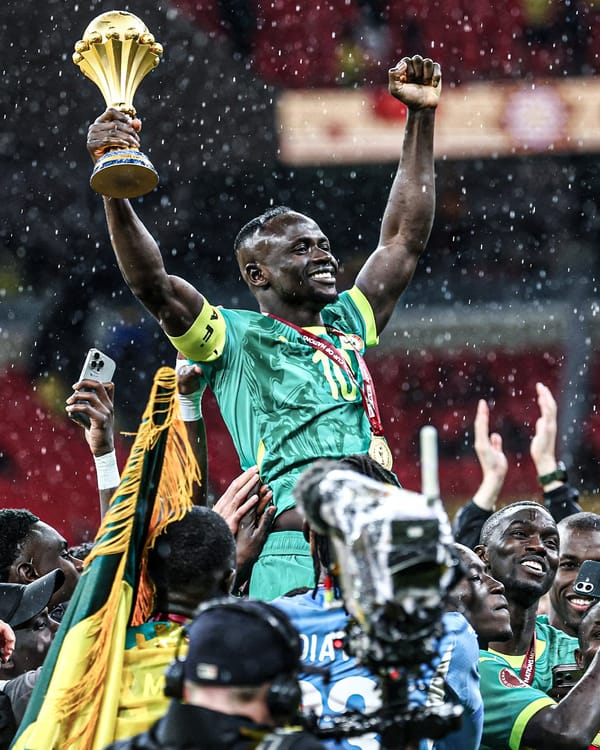
When Sadio Mané first kicked a ball along the dusty roads of Bambali, a small village in southern Senegal, few outside his community would have predicted the global journey that lay ahead that has since seen him be crowned 2 time African Player of the year Award and CAF AFCON twice. There were no state-of-the-art academies, no professional scouts lining up to spot him. Just a boy in torn boots and worn shorts, driven by instinct and love for the game.
Today, Mané stands among the most recognizable names in world football—not merely for his goals and trophies, but for what his story tells us about the deep, often untold realities of African football.
This is the first installment in Sport Blot’s African Football Canon, a series exploring the defining careers that shaped how the world sees African sport.
A Beginning Shaped by Landscape and Limitation
Sadio Mané’s journey begins far from the polished surfaces of European training grounds. Growing up in Bambali and later in Sedhiou, he played wherever space allowed—on dirt roads, in open fields, and in informal local games. It was only at 15 that he ventured nearly 500 miles to Dakar for a trial, turning up in worn equipment that could have discouraged any scout—but did not.
His acceptance into Génération Foot, a humble Senegalese academy with limited resources but exceptional vision, marked Mané’s first major turning point. This was not a pipeline for instant superstardom, but it bridged local talent to European opportunity—a hallmark of many modern African football success stories.
Redefining Pathways: Europe Without Prestige
Unlike many youth fantasies of signing immediately for elite clubs, Mané’s early European trajectory was modest. From FC Metz in France, he later joined Red Bull Salzburg in Austria—steps that were important for development but largely under the global radar. These phases of his career challenge a common assumption: that African stars must be discovered early by elite scouts to succeed.
They underline instead a distinct African truth: sustained resilience and adaptability through less glamorous channels can be as formative as early hype.
The Premier League Arrival That Echoed Worldwide
When Mané signed for Southampton in 2014, his first goal in the Premier League was not a global headline. But it was the first signal that his talent would not remain confined to local admiration. In England’s top flight, he began to dismantle stereotypes—blending pace, work ethic, tactical intelligence, and clinical finishing in ways that forced the world to take notice.
His rapid hat-trick in 2015 became more than a record—it became a statement: African players from humble origins can not only compete in elite football ecosystems but excel and redefine them.
Liverpool, Leadership, and Continental Impact
Moving to Liverpool in 2016 transformed Mané from an exciting talent into a global phenomenon. The senagelse forward became the most expensive African player in history at that time and was Jürgen Klopp's fourth signing for the 2016/17 season. He scored 120 goals in 269 games for the club.
But perhaps more consequential was his influence beyond club success. With Senegal, Mané helped secure Africa’s most coveted trophy—the Africa Cup of Nations—for the first time in the nation’s history in 2021, scoring the winning penalty and securing tournament MVP honors. His leadership on the pitch was again on display more recently when he played a pivotal role in Senegal’s dramatic 2026 AFCON victory—convincing his team to complete a controversial final rather than abandon the match, exemplifying resolve as much as skill.
Beyond Football: Legacy, Identity, and Responsibility
Sadio Mané’s rise is not just about athletic excellence—it is also a story of impact and identity. He has used his success to catalyze change in Bambali: funding hospitals, schools, a football stadium, even internet access.
His life forces us to reckon with an expanded definition of what it means for African athletes to arrive on the world stage. It’s not merely about goals, trophies, or global endorsement deals; it’s about community transformation, representation, and enduring social responsibility. For many young Africans, Mané is not just an inspiration on the field—he’s proof that global success can fuel local renewal.
What This Reveals About African Sport
In this opening chapter of Sport Blot’s African Football Canon, Sadio Mané’s story reveals three truths we might now understand differently:
- Pathways matter as much as potential: Mané’s rise shows that talent can emerge from unconventional routes and still reach the highest levels.
- African identity in sport is multifaceted: Success encompasses leadership, community impact, and cultural resonance—not just individual accolades.
- Legends are more than their statistics: What defines a great African athlete is often how they transform the world that raised them.
Sadio Mané announced his arrival not in a single moment, but through a lifetime of resilience, leadership, and rootedness. His story reframes how we see African football—not as a producer of sporadic stars, but as a wellspring of profound, enduring excellence.


Related News
The 10 Greatest African Pundits in 2026
Mar 03, 2026
Top 10 African Female Footballers to Watch at WAFCON 2026
Feb 21, 2026
Top 10 Most Expensive Transfers Between African Football Clubs
Feb 16, 2026