Table of Contents
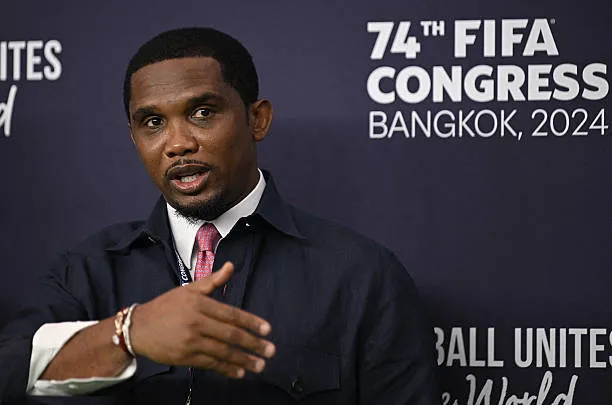
Samuel Eto'o gave an interview to L'Equipe on Tuesday that landed on the same week AFCON 2027 qualification opens, and the timing is not incidental. The Cameroonian Football Federation president told the French publication that African football federations should support Gianni Infantino for re-election at the FIFA Congress on March 18, 2027, crediting the FIFA president with accelerating continental development and expanding World Cup access for smaller nations. President Gianni Infantino has changed football, Eto'o said. He has helped our continent. He has helped our federations develop much more quickly, and we have to recognise that.
The statement places Eto'o on the explicit opposite side of an increasingly public divide between FIFA's African support base and UEFA's confrontational posture toward Infantino over the now-abandoned FIFA Forward Enterprise proposal. UEFA has pursued a US court complaint seeking evidence for a potential criminal case in Switzerland against Infantino and other FIFA officials. Eto'o's intervention, in a major French football publication, is a deliberate contribution to a governance debate that will define the direction of world football through to the 2030 World Cup and beyond. African football's relationship with FIFA funding, specifically the Forward programme that Eto'o credited with helping finance the FECAFOOT headquarters and other federation infrastructure, is the specific commercial argument beneath the political one. We can never have the same perception of things, Eto'o said. When you see some federations with budgets of 150,000 euros, how can they compete with the big countries?
The FECAFOOT Context and Why It Complicates the Statement
Eto'o's public intervention in FIFA politics arrives at a moment when his own federation's governance record is the subject of live scrutiny. He was re-elected as FECAFOOT president in December 2025, receiving 85 of 85 votes at a General Assembly that the Cameroonian education ministry, which oversees the sports portfolio, had called to be cancelled. Demonstrations outside the venue accompanied the vote. Critics have accused Eto'o of mismanagement, of contributing to Cameroon's failure to qualify for the 2026 World Cup, and of an institutional feud with the Ministry of Sports that has damaged the programme's stability. He received a six-month FIFA ban in 2024 for conduct at a Women's Under-20 World Cup match. He was suspended by CAF for alleged misbehaviour during AFCON 2026.
A statement of support for Infantino from Eto'o will therefore be read through two different lenses simultaneously. The lens of genuine continental conviction: African federations operating on small budgets have material reasons to value a FIFA president who has expanded World Cup slots and distributed development funding. And the lens of political positioning: a federation president whose own governance has been contested, aligning himself publicly with the incumbent FIFA president at the moment when that president faces his most serious institutional challenge. Both readings are valid. Neither cancels the other. What Eto'o said about FIFA's relationship with African football is factually grounded. That it was said by Eto'o, now, in L'Equipe, is not a neutral act.
AFCON 2027 Qualification Opens This Week
The first matchday of the AFCON 2027 qualification campaign runs from September 5 to 9. Across the eleven groups, 44 competing nations play their opening fixtures. The most watched first-round matches are South Africa hosting Guinea on September 26, which is outside this week's window and is Pitso Mosimane's first match in charge, and the earlier September 5 and 6 fixtures involving Nigeria, Ghana, Egypt and Senegal in their respective groups. Nigeria's Group I opener will be the first competitive examination of Eric Chelle's squad-building approach. Ghana's Group B fixture is being managed by a caretaker setup with the permanent coaching appointment still unresolved. Senegal open Group F in an edition where the title they won on the pitch in January remains contested in a Swiss courtroom.
The results from this week's opening round will not settle any of the major qualification questions. They will set the tone for campaigns that run through 2026 and into next year. What they will confirm is which of the continent's major programmes begin their AFCON 2027 campaigns with the kind of tactical coherence and squad certainty that makes early qualification points look like management rather than scrambling. Sport Blot will carry the full first-round results and the updated group standings when the September window closes on September 9.