
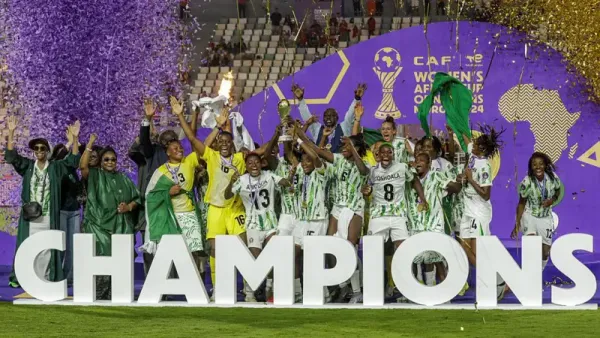

With less than two weeks to its scheduled kick-off, the 2026 Women's Africa Cup of Nations has been thrown into chaos. Behind the logistical fog lies a far older and more troubling story.
Somewhere in Abuja, Lagos, Accra, and Lusaka, a women's footballer laced up her boots this week and went to training — not knowing whether the tournament she has spent months preparing for will actually take place. Her federation has not told her. Neither has CAF. The closest thing to an answer she has received is a social media post from a BBC Sport graphic that reads: POSTPONED UNTIL JULY.
That graphic, and the silence surrounding it, tells you almost everything you need to know about where women's football sits in the priorities of African football's governing body.
The announcement has come less than two weeks before the tournament was scheduled to start in Morocco ❌ pic.twitter.com/R5lCOxDAhd
— BBC Sport (@BBCSport) March 5, 2026
How Did We Get Here?
The 2026 Women's Africa Cup of Nations (WAFCON) was scheduled to run from 17 March to 3 April in Morocco — the third consecutive time the North African nation would host the continent's premier women's football competition. The tournament had been expanded to 16 teams for the first time, a milestone that, on paper, pointed to a growing commitment to the women's game across the continent.
But the warning signs were there early. In February, South Africa's Deputy Minister of Sports, Arts and Culture, Nocawe Mafu, told SABC Sport that South Africa had stepped in to replace Morocco as hosts — only for her country's own Minister of Sports, Gayton McKenzie, to publicly walk back her comments as premature. CAF denied any crisis. Business as usual, they said.
It was not business as usual. Behind the scenes, according to multiple reports citing sources within CAF, the Royal Moroccan Football Federation had been warning the confederation for weeks that it would be impossible to host the tournament in March as planned. The reasons given were logistical: Morocco's domestic league, the Botola Pro, had been pushed back by a congested calendar of events — including the men's AFCON, the Arab Cup, and the African Nations Championship — and a series of international men's friendlies was also set to use the country's stadia during the same window.
On 27 February, CAF reportedly made the decision to postpone in a meeting of its Executive Committee — with sources describing the session as tense, and CAF President Patrice Motsepe reportedly declining to directly address WAFCON during deliberations. Despite the decision being taken, no official announcement followed. No new dates. No new venues. Just silence — and growing fury from players, coaches, federations, broadcasters, and sponsors who had all invested months of preparation into a tournament that now existed in limbo.
The Men's Game Came First — As It Always Does
To understand what happened to WAFCON 2026, you have to understand the broader context of Morocco's football infrastructure in early 2026. The country has become the continent's default host for major events — a role it has embraced with genuine investment, world-class facilities, and a growing appetite for international football. But that same status has created a scheduling bottleneck that the women's game has paid for.
The sixth edition of Morocco's "Capital of African Football" tournament — a men's event featuring eight national teams — was set to take place from 23 to 31 March 2026, almost perfectly overlapping with the WAFCON window. A dozen men's national teams were set to descend on the country for international friendlies during the same FIFA break. Morocco's men's national team, preparing for the 2026 World Cup, also had fixtures abroad in the same period.
None of these men's events were postponed. None of them were asked to move. The question of why men's international friendlies took precedence over what CAF itself describes as the jewel of Africa's women's football calendar — a question that ESPN's Ed Dove asked plainly in his analysis — has received no satisfactory answer from either CAF or the Moroccan federation.
The answer, of course, is obvious to anyone who has followed African football governance for more than a few months. The men's game generates more commercial interest, more media attention, and more political capital. When schedules clash, the women's game yields. This has happened before — and unless something changes at a structural level, it will happen again.
The Stakes Are Higher Than a Trophy
What makes this particular postponement more than just an administrative embarrassment is what WAFCON 2026 was supposed to double as: the qualifying tournament for the 2027 FIFA Women's World Cup in Brazil. Africa's four representatives to that tournament were meant to be determined through the results of this competition. Without WAFCON — or without a credible replacement pathway — African women's football faces the prospect of its nations being locked out of the World Cup without ever having had a fair chance to compete for those spots.
This is not a hypothetical concern. It cascades. Players whose club contracts are tied to international appearances, sponsors whose agreements were built around tournament windows, broadcasters who had cleared scheduling space — all of them are now left hanging. Morocco themselves, having invested heavily in their women's programme — including appointing Spain's World Cup-winning coach Jorge Vilda to lead the Lionesses — could face consequences including a ban from the tournament and the loss of their World Cup qualification pathway if they are found to have refused to fulfil their hosting obligations.
Meanwhile, Nigeria's Super Falcons — ten-time African champions and the defending WAFCON title holders — had already entered their training camp. So had Zambia, Ghana, South Africa, and every other one of the 16 qualified teams. Their federations are now expected to absorb the financial cost of additional preparation camps whenever the tournament is eventually rescheduled. CAF has not indicated it will compensate them.
A Pattern, Not an Incident
It would be tempting to treat this as a one-off failure — a scheduling conflict that spiralled out of control because of bad luck and poor communication. But that framing lets the relevant parties off far too lightly.
Morocco knew two years ago that they were hosting WAFCON in this window. CAF knew. Yet with under two weeks to kick-off, there had been no finalisation of the competition calendar, no confirmation of venues for the knockout rounds, no accreditation issued, no tournament officials named, no media workshop hosted, and no security deployment to the competition sites. These are not things that simply fall through the cracks. They are institutional failures that reflect how much — or how little — urgency was applied to making this tournament happen.
CAF's stated commitment to women's football has grown louder in recent years. The expansion of WAFCON to 16 teams was itself a product of that stated commitment. But stated commitment and operational commitment are two very different things. You cannot claim to be investing in the women's game while simultaneously allowing a tournament to collapse without so much as an official press release explaining why.
The women who play this game — who train through limited resources, inadequate facilities, and underinvestment that their male counterparts would never tolerate — deserve better than to find out their tournament has been postponed through social media. They deserve a governing body that treats their competition as essential, not as a calendar item to be shuffled aside whenever something more commercially attractive needs the same date.
What Comes Next
As of this writing, CAF has promised an official statement clarifying the tournament's fate. Reports we have seen suggest a July or August window is under consideration, with Morocco likely to retain hosting duties — though South Africa, which had briefly expressed willingness to step in, remains a potential alternative. Algeria was reportedly approached and declined.
A July rescheduling creates its own complications. The 2026 FIFA World Cup for men runs from 11 June to 19 July in the United States, Canada, and Mexico. A WAFCON tournament running concurrently with the world's biggest football event would struggle to attract broadcast attention, sponsorship visibility, or the kind of global audience that women's football in Africa is slowly but genuinely beginning to build.
That would be the final cruel irony of this whole episode: a women's tournament postponed to make way for men's friendlies, then rescheduled into a window dominated by a men's World Cup. The women's game, once again, left to find its audience in the gaps.
The WAFCON postponement is not just a scheduling problem. It is a mirror held up to African football governance — and to the continent's willingness to treat its women footballers as first-class citizens of the game they have dedicated their lives to. Until the reflection in that mirror changes, no amount of expanded formats or expanded squads will tell a different story.
Related News
Top 10 African Female Footballers to Watch at WAFCON 2026
Feb 21, 2026
South Africa Snatches WAFCON 2026 Hosting After Morocco’s Shock Last-Minute Withdrawal
Feb 03, 2026
All Teams Qualified for the 2026 Women’s Africa Cup of Nations
Oct 30, 2025