
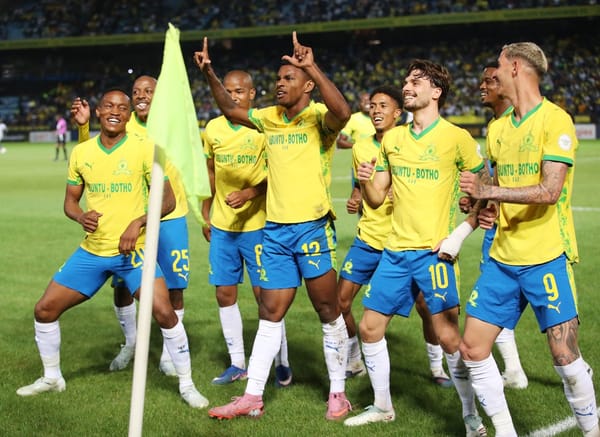

As the final whistle echoed across stadiums from Bamako to Pretoria, the CAF Champions League once again delivered drama, tension, and defining moments. Mamelodi Sundowns’ progression into a fourth consecutive semi-final stands out as more than just another milestone; it is a statement of sustained excellence in a competition defined by volatility. Their consistency at this level, in a tournament where momentum can shift quickly, has reinforced their position among Africa’s elite and elevated the conversation around what truly defines a complete team. Built on tactical discipline, squad depth, and a resilient winning mentality, Sundowns have developed a structure that allows them to compete and adapt under pressure. The question now is whether this level of control and consistency makes them the benchmark that the rest of the continent must chase.
Resilience Over Perfection: The Bamako Test
Sundowns’ journey to the semi-finals was anything but straightforward. CAF Online reports highlight that the South African champions advanced with a 3-2 aggregate victory over Stade Malien, despite suffering a 2-0 defeat in Bamako. Their dominant 3-0 first-leg performance in Pretoria ultimately proved decisive, but the second leg exposed vulnerabilities that challenge the idea of complete dominance.
This contrast between control at home and fragility away raises important questions. A truly complete team is expected not only to dominate but also to manage adversity seamlessly. Sundowns showed resilience, holding on despite being reduced to ten men and facing relentless pressure, but the struggle itself suggests that completeness in African football may not necessarily mean perfection.
There is, however, a compelling counterargument to their growing reputation. Being convincingly beaten 2-0 in Bamako, as detailed in CAF Online coverage, reveals that Sundowns can be disrupted when removed from their comfort zone. A complete team, by definition, should impose itself in all environments, yet Stade Malien were able to unsettle their rhythm, press aggressively, and dictate large phases of the match. This raises a critical doubt: are Sundowns truly complete, or are they a dominant side that still shows situational vulnerability, particularly away from home?
That question will be tested immediately in the semi-finals. Sundowns are set to face Espérance Sportive de Tunis, one of the continent’s most experienced and tactically disciplined sides. The two-legged tie, with the first leg in Tunisia and the return match in Pretoria, presents a different level of challenge. Esperance’s ability to control games at home and manage high-pressure knockout fixtures will demand a more complete performance from Sundowns across both legs.
Stade Malien coach Mauril Njoya’s post-match reflections, as reported by Soccer Laduma, provide a valuable opposing perspective. “Simply to say that we left the competition disappointed, because any coach in my place would be disappointed… we had the ability and the possibility to go as far as possible, to go to the semi-final and why not to the final,” he admitted. His words underline how close Sundowns came to losing control of the tie. The implication is clear: while Sundowns advanced, they were pushed to their limits by a side that believed it could match them.
Njoya’s remarks reveal that Sundowns’ aura is not invincible. Instead, their strength lies in surviving moments where others might collapse, a trait that is often more valuable than outright dominance in knockout football.
Cardoso’s Philosophy: Control, Caution and Growth
At the heart of Sundowns’ evolution is head coach Miguel Cardoso, whose approach blends ambition with caution. Speaking ahead of the second leg, he made his mindset clear in comments carried by The Star. “We cannot think that things are done. They need to be controlled by us. The Champions League is not a story that’s written yet.”
This perspective is central to understanding Sundowns’ identity. Rather than assuming superiority, Cardoso emphasizes control and continuous effort. His insistence that nothing is guaranteed reflects an awareness of the unpredictable nature of African club football, where travel, conditions, and officiating can all influence outcomes.
His approach also highlights a key element of completeness: mental discipline. Sundowns are not just technically strong; they are psychologically prepared to approach each game with caution. This mentality was evident in Bamako, where, despite losing the match, they managed the aggregate scoreline effectively.
Further reinforcing this idea, Cardoso has previously pointed to the quality within his squad. As reported by Foot Africa, he stated, “It’s important to understand that this team of Mamelodi Sundowns has some of the best players on the continent.” This assertion speaks to the depth and talent available to him, but it also raises expectations. Having top players is one thing; consistently translating that into continental dominance is another.
His words suggest that Sundowns’ completeness is built on a strong foundation of individual quality, but their true test lies in how consistently they can convert that into collective success.
Sundowns’ Structure and Recognition Within the Game
Mamelodi Sundowns’ claim to being Africa’s most complete club is rooted in how they function as a collective. Their ability to control matches, rotate without losing quality, and impose a consistent style of play points to a system that extends beyond individual influence. It is this balance between structure and execution that continues to define their dominance.
That structure has drawn recognition from within the coaching fraternity. Speaking to The South African, Portuguese coach Luís Gonçalves highlighted the consistency behind Sundowns’ performances. “Cardoso is moving according to the expectations of a club like Sundowns. He has been in two finals of the Champions League and now is in the semi-finals after having competed at the Club World Cup, so it shows there is plenty he is doing right with his work.”
While the comment is directed at the coach, it reflects the team’s sustained output in elite competitions. Reaching multiple finals and semi-finals is not simply a reflection of technical ability, but of a system that produces results across different seasons and conditions.
Gonçalves also pointed to the clarity behind that system, as noted in reporting by Goal.com. “I have always known him to be a coach who is clear with his ideas, and it is showing with his work at Sundowns. From what I’m observing from a distance, Cardoso has taken Sundowns forward.”
That clarity is evident in Sundowns’ play. Their positional discipline, control in possession, and ability to manage transitions reflect a team that understands its identity. Even when personnel changes, the structure remains intact.
In that sense, the recognition from within the game reinforces a broader reality. Sundowns are not defined by moments or individuals, but by a system that consistently delivers. That is what strengthens their case as Africa’s most complete club.
Consistency as a Marker of Greatness
One of the most compelling arguments in favour of Sundowns’ completeness is their consistency at the highest level. CAF Online coverage emphasizes that this is their fourth consecutive semi-final appearance, a remarkable achievement in a competition known for its unpredictability.
Consistency in African football is notoriously difficult to achieve. Factors such as long travel distances, varying pitch conditions, and differing tactical approaches across regions create an environment where even top teams can falter. Sundowns’ ability to navigate these challenges year after year speaks volumes about their structure and resilience.
However, consistency also invites scrutiny. Despite their repeated deep runs, Sundowns have not converted these opportunities into multiple titles in recent years. This raises an important question: can a team be considered the most complete without consistently winning the ultimate prize?
The answer may lie in how completeness is defined. If it is measured purely by trophies, Sundowns still have work to do. But if it is assessed through sustained competitiveness, tactical clarity, squad depth, and mental resilience, their case becomes much stronger.
The African Context: Completeness Beyond Results
In the African football landscape, completeness must be understood within a broader context. Success is not determined solely by what happens on the pitch. Administrative stability, financial backing, and long-term planning all play crucial roles.
Sundowns benefit from strong institutional support, allowing them to build a squad capable of competing at the highest level consistently. This stability sets them apart from many rivals, who often face disruptions that hinder long-term progress.
At the same time, their journey highlights the challenges of maintaining dominance in a rapidly evolving continental scene. Clubs from North and West Africa continue to strengthen, while emerging teams are becoming increasingly competitive. Sundowns are no longer just chasing success; they are defending their position as a benchmark.
Why Sundowns May Be Africa’s Most Complete Club Right Now
Mamelodi Sundowns’ run to a fourth consecutive CAF Champions League semi-final confirms their status as Africa’s most complete club at this moment. This is not a claim built on results alone, but on a clear and consistent foundation. Under Miguel Cardoso, they have combined tactical clarity, squad depth, mental resilience, and strong institutional backing into a system that performs across different contexts.
The defeat in Bamako does not weaken that argument. It reinforces it. In a competition defined by unpredictability, the ability to absorb pressure, adapt, and still progress is what separates strong teams from complete ones. Sundowns have shown that they can do exactly that.
In a continental landscape where inconsistency remains common, Sundowns have established a level of control and continuity that others have not matched. Right now, they are not just competing with Africa’s best. They are setting the standard.