
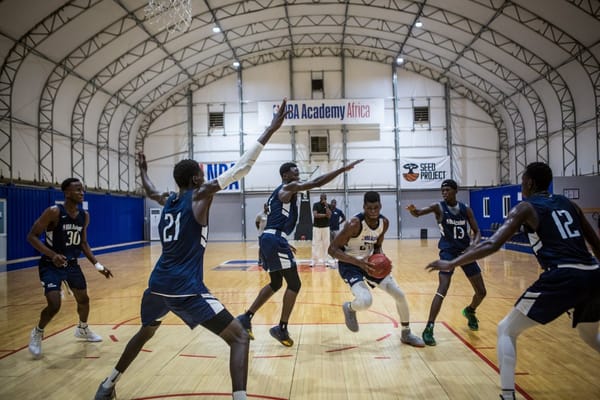

African basketball is no longer defined by isolated success stories. In the 2024–25 NBA season, African talent represents a complete ecosystem: MVP-level superstars, championship contributors, elite draft picks, and academy-developed prospects.
What makes this moment different is not just the presence of African players, but their influence. They are leading franchises, anchoring defenses, breaking draft barriers, and shaping playoff narratives. The growth of systems like NBA Academy Africa and the strengthening of pathways from the Basketball Africa League (BAL) have transformed Africa from a talent supplier into a structured development force.
This latest ranking highlights seven figures, players, and prospects who best represent Africa’s current and future footprint in the NBA, starting from emerging impact to established dominance.
7. Yves Missi (Cameroon) – New Orleans Pelicans
Yves Missi’s rise reflects the speed at which African prospects are now developing. Selected 21st overall in the 2024 NBA Draft by the New Orleans Pelicans, he immediately validated that investment.
During the 2024–25 season, Missi earned NBA All-Rookie Second Team honors after leading the Pelicans in total minutes (1,956) and games played (73). For a rookie to log that workload signals trust, not just potential. He also ranked 1st among rookies in rebounds (601) and 3rd in blocks (98), showing that his defensive impact translated instantly.
At Baylor, he averaged 10.8 points and 5.7 rebounds in his lone college season — flashes that hinted at upside. But in the NBA, he proved durability, rim protection, and rebounding at scale. Add his role in helping Cameroon reach the AfroBasket semifinals in 2025, and Missi’s profile becomes clear: he is not just athletic — he is reliable.
That reliability is what makes him one of Africa’s most promising young NBA big men.
6. Josh Okogie (Nigeria) – Phoenix Suns
Josh Okogie’s value cannot be measured purely in scoring averages. Drafted 20th overall in 2018, he has built a reputation as one of the NBA’s most persistent perimeter defenders.
With the Phoenix Suns, and previously the Timberwolves and Hornets, Okogie has consistently guarded elite scorers. His high block percentage for a wing and defensive disruption metrics place him in strong percentile categories among forwards.
At Georgia Tech, he averaged 16.9 points and 5.8 rebounds over two seasons and was named to the 2017 ACC All-Freshman Team. But his NBA role has evolved into something more specialized, with energy, defensive pressure, and playoff reliability.
Nigeria continues to produce the highest number of African NBA players, and Okogie represents that depth. He may not headline MVP conversations, but championship teams need players who can defend at elite levels without demanding offensive volume.
5. Jonathan Kuminga (DR Congo) – Golden State Warriors
Drafted 7th overall in 2021, Jonathan Kuminga entered the NBA as raw potential. By 2025, he is becoming production.
He won an NBA Championship in 2022 at just 19 years old, making him the second-youngest champion in league history. Since then, he has grown into a key scorer for the Golden State Warriors, becoming the youngest Warrior to reach 1,000 career points and setting a franchise record for most dunks in a season.
His evolution matters. In December 2024, he dropped a career-high 34 points and recorded an 11-for-11 shooting performance against Atlanta, matching a franchise efficiency mark. Those moments show not just athleticism, but also improving decision-making and scoring control.
Kuminga represents the modern African forward: explosive, versatile, and increasingly efficient.
4. Jean-Jacques Boissy (Senegal) – BAL Champion & NBA G League Star
Jean-Jacques Boissy’s rise illustrates Africa’s ability to produce complete, NBA-ready guards from its academy systems. A graduate of NBA Academy Africa, Boissy dominated the 2025 Basketball Africa League (BAL), leading Al Ahli Tripoli to the championship while earning league MVP and scoring champion honors. His combination of scoring prowess, playmaking, and elite defensive instincts makes him one of the continent’s most well-rounded talents.
Boissy’s impact extends beyond club basketball. He spearheaded the Senegal national team to a bronze medal at AfroBasket 2025, highlighted by a career-high 40-point performance, underscoring his ability to perform under international pressure. Recognized defensively as well-named to the BAL All-Defensive First Team in 2023 and 2025, he is as disruptive on defense as he is dynamic on offense.
Professionally, Boissy has continued his ascent via the NBA G League, being drafted 5th overall in the 2025 NBA G-League International Draft by the Memphis Hustle and later joining the Windy City Bulls. These achievements signal that his dominance in Africa is translating toward the NBA pathway.
Boissy embodies the modern African guard: a scoring threat, a defensive anchor, and a product of Africa’s structured talent development. He is living proof that the NBA Academy and BAL pipeline can cultivate elite players ready to make a global impact.
3. Khaman Maluach (South Sudan) – 10th Overall Pick, 2025 Draft
Khaman Maluach’s story is structural as much as it is personal.
Selected 10th overall in the 2025 NBA Draft (Houston, later traded to Phoenix), he became the highest-drafted player to emerge directly from NBA Academy Africa. That milestone signals institutional success.
Standing 7’2”, Maluach is known for elite rim protection and mobility. He starred in the Basketball Africa League, helped AS Douanes reach the 2023 BAL Finals, and represented South Sudan at both the 2023 FIBA World Cup and 2024 Paris Olympics; a rare experience for a player his age.
What makes him elite is his trajectory. He began organizing basketball at 15 and reached NBA lottery status within a few years. That rapid development speaks to coaching infrastructure, scouting investment, and Africa’s rising global basketball credibility.
2. Pascal Siakam (Cameroon) – Indiana Pacers
Pascal Siakam represents sustained excellence.
An NBA Champion (2019), 4-time All-Star, and former Most Improved Player, Siakam has proven he can thrive both as a complementary star and as a primary option.
With the Indiana Pacers, he earned Eastern Conference Finals MVP in 2025, showing that his playoff impact remains elite. His All-NBA selections (Second Team 2020, Third Team 2022) reflect consistent top-tier performance.
What separates Siakam is versatility. He defends multiple positions, thrives in transition, and scores efficiently in half-court sets. His journey, from late introduction to basketball in Cameroon to G League Finals MVP to NBA champion, remains one of the most complete developmental arcs among African players.
1. Joel Embiid (Cameroon) – The Apex
At the top stands Joel Embiid.
The 2022–23 NBA MVP, two-time scoring champion, and 7-time All-Star, Embiid, remains Africa’s most dominant basketball force. His 70-point performance for the Philadelphia 76ers in January 2024 broke franchise records and reaffirmed his offensive supremacy.
He became the first center since Bob McAdoo in the 1970s to win back-to-back scoring titles and the first international player to lead the league in scoring.
What makes Embiid number one is not just awards; it is control. He dictates matchups, draws double teams, and anchors both ends of the floor. In terms of sustained dominance and league-wide influence, no African player has reached his level.
Also read: Top 10 African Nations Producing NBA Talent in 2025
Why This Moment Matters for Africa
This era of African NBA talent is not accidental.
It is the product of infrastructure, belief, and generational evolution.
Joel Embiid represents the breakthrough, proof that an African-born player can dominate the league and win MVP.
Pascal Siakam represents development, a player who grew within the system and became a championship star.
Jean-Jacques Boissy represents modern winning basketball, defense, versatility, and efficiency.
Kuminga and Missi represent ascension.
Maluach represents the pipeline finally working at full capacity.
What separates 2025 from previous decades is depth.
There was a time when Africa celebrated one star at a time, Hakeem Olajuwon, then a long gap, then isolated success stories. Now, African players exist across tiers:
Related News
Michael Kayode: The Brentford Right-Back Whose Long Throw-Ins Are Redefining Set-Piece Play in African Football Contexts
Feb 15, 2026
Top 20 African Football Stars on the Scout Watchlist
Dec 09, 2025
Endrick to United? The Teen Sensation Saga That's Got Ferguson Nodding in Approval
Nov 15, 2025