Table of Contents
The financial landscape of African women's football has changed faster in the past five years than in the previous fifty. The combination of the NWSL's salary expansion, the Saudi Pro League's investment in the women's game, Lyon's dominance of the European transfer market, and the growing commercial appetite around the Women's Africa Cup of Nations has produced the first generation of African female players who are genuinely wealthy by any comparative standard, not merely well-compensated by the historical norms of the women's game on the continent. The players in this ranking have earned their money in the hardest professional environments the sport offers: Champions League campaigns, NWSL play-off runs, World Cup golden boots, and the kind of sustained club form that attracts sponsorship at the level of Nike and Pepsi rather than domestic brands. The ranking combines estimated net worth, current annual earnings, endorsement income, and transfer fee history. It is a portrait not only of individual achievement but of how much ground African women's football has covered in a single decade.
10. Chiamaka Nnadozie -- Nigeria -- Approximately 500,000 Euros
Chiamaka Nnadozie is 23 years old and already has a Ballon d'Or nomination to her name. The Nigerian goalkeeper moved to Brighton and Hove Albion in the Women's Super League after establishing herself as one of the most technically accomplished shot-stoppers in African women's football during her seasons in France. She was a nominee for the 2025 Yashin Trophy alongside her Ballon d'Or recognition, an extraordinary position for a goalkeeper of her age from any continent. Her net worth is estimated at approximately 500,000 euros, combining her WSL salary, the WAFCON winner's bonus she collected earlier in 2026, and the early endorsement conversations that follow Ballon d'Or lists. Nnadozie is the youngest player in this ranking and the one whose financial position is most likely to look significantly different in the next two years if her European trajectory continues at its current rate.
9. Jennifer Echegini -- Nigeria -- Approximately 400,000 Euros
Jennifer Echegini won the MAC Hermann Trophy in 2023, the most prestigious individual award in American college football, and moved to Paris Saint-Germain where she plays alongside Rasheedat Ajibade in one of the most expensive midfield units in the women's game. Her route from the US college system through Juventus to PSG in the space of three years reflects the compressed timeline of elite player development in the current era of women's football, where the gap between college graduation and Champions League football has narrowed to almost nothing for the most talented players. Echegini's annual earnings at PSG are estimated at approximately 100,000 euros, and her accumulated career income including prize money, the Juventus salary that preceded her Paris move, and early endorsement agreements places her net worth in the region of 400,000 euros. Her ranking position will rise as her PSG career develops.
8. Onome Ebi -- Nigeria -- Approximately 450,000 Euros
Onome Ebi's place in this ranking is the product of duration more than peak salary. She has appeared at multiple Women's World Cups for Nigeria across a career spanning more than two decades, and the accumulated earning power of that consistency -- club contracts across Nigeria, Europe, and the Gulf, international appearance fees, and the seniority bonuses that long-serving national team players accrue across multiple tournament cycles -- has produced a financial position that contemporaries who earned more at any single club have not always matched across a career. Ebi is a trailblazer in Nigerian women's football in the most literal sense: she was present and performing at a level that attracted professional contracts before most of the players below her in this ranking had made their senior debuts. Her estimated net worth sits around 450,000 euros, the product of longevity in a sport that has rewarded longevity more generously with each passing cycle.
7. Linda Motlhalo -- South Africa -- Approximately 500,000 Euros
Linda Motlhalo is the kind of player whose financial position tells you more about what technical midfield quality is worth in the modern women's game than almost any other metric. She has played across Sweden, Brazil, and the United States, which is a sequence of markets that reflects three different football economies and three different salary structures, and she has attracted South African commercial partnerships alongside her club income that give her earnings a domestic dimension her international peers in smaller markets cannot access. Motlhalo's estimated net worth sits at approximately 500,000 euros, shared with Nnadozie at the bottom of the top ten, and the South African commercial market, which has invested more substantially in women's football endorsements than any other sub-Saharan economy, continues to provide a financial floor under players of her profile that players from smaller markets simply do not have access to.
6. Ajara Nchout -- Cameroon -- Approximately 650,000 Euros
Ajara Nchout has spent more than a decade making herself available to clubs across Norway, Sweden, Italy, and the Middle East, and the cumulative financial effect of those moves, combined with the tournament bonuses she has earned as one of Cameroon's most consistently present performers at Women's World Cups, has produced a net worth estimated at approximately 650,000 euros. She is the captain of the Indomitable Lionesses and her current contract, which she extended to run through 2026, reflects the value that clubs operating in less commercially saturated markets than the WSL or the NWSL still place on experienced African players with international profiles. Nchout's career is also a study in how mentoring and ambassador roles around the game contribute to a player's earnings: she has been involved in commercial and development activities in Cameroon and across francophone West Africa that go beyond the club salary and international appearance fees that define the financial position of younger players in this ranking.
5. Tabitha Chawinga -- Malawi -- Approximately 1 Million Euros
Tabitha Chawinga is the first Malawian player ever to compete in the UEFA Women's Champions League, and she arrived at Olympique Lyonnais via a Serie A Golden Boot, which is the kind of career arc that the Italian league's investment in African attacking talent has made possible in the current era. Her annual earnings at Lyon are estimated at approximately 450,000 euros, the product of a contract negotiated from the position of a proven European goalscorer rather than a development prospect, and her accumulated net worth sits at approximately one million euros when club income across Italy and France, Champions League appearance fees, and commercial agreements in the Malawian market are combined. Chawinga's presence on this list is itself a statement: Malawi has not been among the historically prominent nations in African women's football, and the fact that one of its players earns at the level of the continent's most decorated programmes reflects how individual talent, when it reaches the right club environments, can outpace national programme infrastructure as a wealth-generating mechanism.
4. Temwa Chawinga -- Malawi -- Approximately 1 Million Euros
The Chawinga sisters are the most remarkable pair of siblings in African women's football history, and Temwa's position at fourth in this ranking, one place above her sister, is settled by two specific achievements. She won the 2024 NWSL MVP award and the NWSL Golden Boot in the same season at Kansas City Current, and she became the first non-European player to be named the IFFHS leading female goalscorer in 2023. Both achievements attracted commercial interest of a kind that goalscoring alone in a European league does not always generate: the NWSL MVP is a brand-level accolade that American sponsors respond to, and the IFFHS recognition gave her a global profile that transcends the bilateral relationship between Malawi and whatever European country she happens to be playing in. Her annual earnings are estimated at 400,000 euros and her accumulated net worth matches her sister's at approximately one million euros. Together the Chawinga sisters have produced approximately two million euros of accumulated wealth from a country whose football infrastructure remains among the most limited on the continent. That fact alone is worth pausing on.
3. Barbra Banda -- Zambia -- Approximately 1.5 Million Euros
Barbra Banda has done things on a football pitch that have no equivalent in the history of African women's football. She scored hat-tricks at both the Olympic Games and the Women's World Cup. She was transferred to Orlando Pride for a fee of approximately 740,000 dollars, one of the largest transfer fees ever paid for a female African footballer, and she was part of the Pride squad that won the 2024 NWSL Championship. Her annual earnings at Orlando are estimated at 525,000 dollars, and her accumulated net worth, built from a career that has taken her through Spanish, Chinese, and American club football and multiple major tournament appearances, sits at approximately 1.5 million euros. Banda's commercial profile has been built partly on the extraordinary nature of the Olympic and World Cup scoring records: there are very few female players from any continent who can point to hat-tricks in both competitions, and brands that sell in the African market understand that those achievements carry recognition far beyond the audience that watches the NWSL weekly. Her position at third reflects career earnings that have accumulated over a longer period and at a higher peak than the Chawinga sisters, even if the annual salary figures are comparable.
2. Thembi Kgatlana -- South Africa -- Approximately 2.5 Million Euros
Thembi Kgatlana won the 2018 African Women's Player of the Year award and scored South Africa's first-ever Women's World Cup goal in 2019. Those two biographical facts frame a career whose commercial dimension has consistently outperformed the salary expectations that attach to players of equivalent footballing achievement in other continental markets. The South African sponsorship landscape, which is the most developed and commercially sophisticated in sub-Saharan Africa for women's football, has amplified Kgatlana's earnings in a way that players from smaller markets with comparable on-field records cannot access. Her annual earnings across club salary and endorsements are estimated at approximately 550,000 dollars, and her net worth sits at approximately 2.5 million euros, the second highest in this ranking. Kgatlana's financial position is also a case study in how the South African commercial market rewards Banyana Banyana players differently from how comparable national programmes reward their most prominent female players elsewhere on the continent: the domestic brand economy responds to women's football success in South Africa at a scale that does not yet exist in Nigeria, Zambia, or Malawi.
1. Asisat Oshoala -- Nigeria -- Approximately 3.2 Million Euros
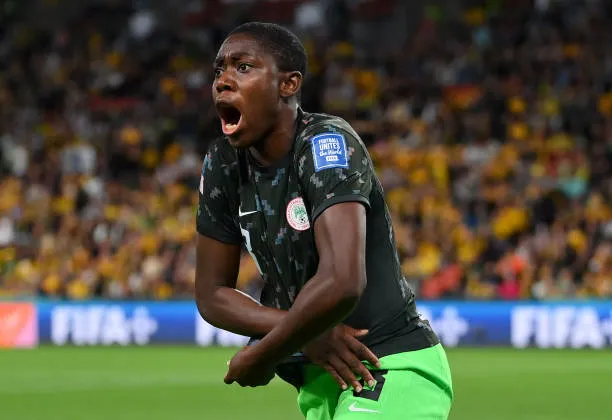
Asisat Oshoala is the richest female African footballer in 2026 and the margin between her financial position and the player behind her is large enough that the ranking's top position is not a close decision. She has won the African Women's Footballer of the Year award six times. She scored more than one hundred goals in European football during her time at Barcelona, where she was the top scorer in the Spanish top division in the 2021-22 season. She holds endorsement deals with Nike and Pepsi. She has invested in real estate. She signed a two-year contract with Al Hilal in Saudi Arabia, where her annual earnings are estimated at approximately 500,000 dollars. The accumulated total of her career income across clubs in England, China, Spain, and Saudi Arabia, combined with six consecutive years of commercial activity at the level of the continent's most celebrated player, has produced a net worth estimated at approximately 3.2 million euros. Oshoala's financial position is not simply the product of her talent, although the talent is the foundation of everything that follows. It is the product of twenty years of sustained excellence at the highest level of the women's game, converted into earnings across multiple markets and an endorsement profile that has grown with every additional Player of the Year award. She is, by a considerable distance, the wealthiest female footballer Africa has produced.
What the List Says
Read together, the ten names in this ranking describe African women's football's financial geography more precisely than any single career can. Nigeria, Zambia, South Africa, and Malawi account for all ten positions. The NWSL, the French Division 1 Feminine, the Women's Super League, and the Saudi Pro League are the clubs paying the salaries. No player in this ranking earns her primary income in an African domestic league. The financial architecture of African women's football is built offshore: players develop on the continent and earn the bulk of their income abroad, remitting some of it home through endorsements, investments, and the commercial relationships that fame generates in domestic markets. The next generation of this ranking will be shaped by how much the domestic league structures on the continent develop in the next decade, whether NWSL-level salaries eventually create competition from within the continent for the players who currently have no financial incentive to stay, and whether the commercial markets in Nigeria and South Africa deepen enough to support players who remain at home. For now, the ten richest female African footballers of 2026 are spread across Saudi Arabia, the United States, England, and France, building wealth in environments that the continent's own football economies have not yet been able to replicate.