Table of Contents
Ten African nations entered the 2026 FIFA World Cup, the most in the tournament's history. Nine reached the knockout stage. None made the semi-finals. That is the statistical frame. What the numbers cannot fully capture is how directly Africa's performances shaped the final that Spain eventually won — and how much of the world's most watched football match was built on drafts written in earlier rounds by African teams.
The Record That Sets the Baseline
Nine of ten African nations advancing beyond the group stage in a 48-team field is a record by any measure. Africa's previous best was five from seven at the 2022 World Cup. The expanded format gave the continent more entries and the teams used them. Cape Verde qualified as debutants. Ivory Coast, South Africa and DR Congo each reached the knockout stage for the first time. Egypt won their first ever World Cup match in the knockout round, beating Australia before falling to Argentina. CAF president Patrice Motsepe said the continent's 1.6 billion people could be proud. The data supports the statement.
Morocco went furthest, reaching the quarter-finals. No other African nation advanced past the last 16. The gap between quarter-finalist and semi-finalist — the distance Morocco could not cover for the second consecutive tournament — remains the continent's operational ceiling. It is a ceiling that is rising. It has not yet been broken.
The Late Goal Problem
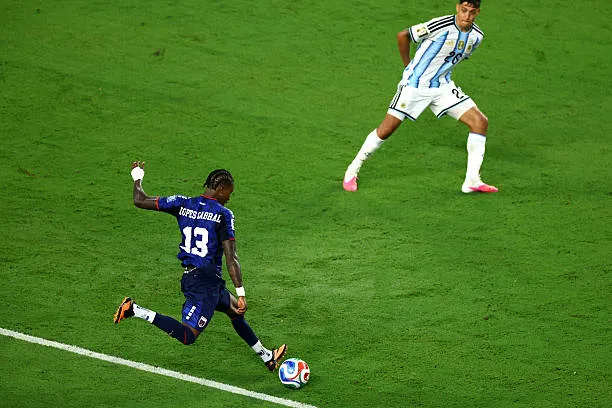
Five African sides lost after holding leads. Senegal led Belgium 2-0 and lost 3-2. Egypt led Argentina 2-0 and lost 3-2. DR Congo led England and lost 2-1. Cape Verde led Argentina in extra time and lost 3-2. This is not a new pattern — it is an old one arriving at a new scale, with more nations producing the leads and more nations failing to protect them.
The irony sits at the centre of the final. Spain's winning formula against Argentina in the final was built on suffocation — controlling possession, denying space, outlasting an opponent whose identity was built around late pressure. The Argentine late-goal machinery had been stress-tested and exposed by African opposition before the semi-finals. Cape Verde and Egypt ran the experiment. They identified the vulnerability, built the leads, and could not hold them. Spain identified the same vulnerability, built nothing until the 106th minute, and won the World Cup.
What Africa Carries Out of 2026
Three numbers matter beyond the trophy count. First: nine from ten. That knockout rate resets continental expectations for 2030, when Africa will be assigned nine automatic slots in a potentially expanded field. Second: Cape Verde's group-stage draw with Spain. Vozinha's eight saves remain the single best defensive performance either finalist faced across the entire tournament. A goalkeeper from a nation of 600,000 people produced the blueprint that no team — not France, not England, not Germany — managed to execute against Spain's attack. Third: the late-goal gap. Five collapses from leading positions is the specific, addressable problem that the next four years must answer.
The gap to a World Cup final, measured not in generations but in minutes held and leads surrendered, has never been smaller. Egypt were eleven minutes from a quarter-final against the eventual world champions. Cape Verde were eleven minutes of extra time from the same. The continent was close. Closeness, without the result, is the most useful kind of data there is. WAFCON 2026 begins in five days. The work continues.